
Ace Data Cloud Studio: All-in-One AI Creation Workspace
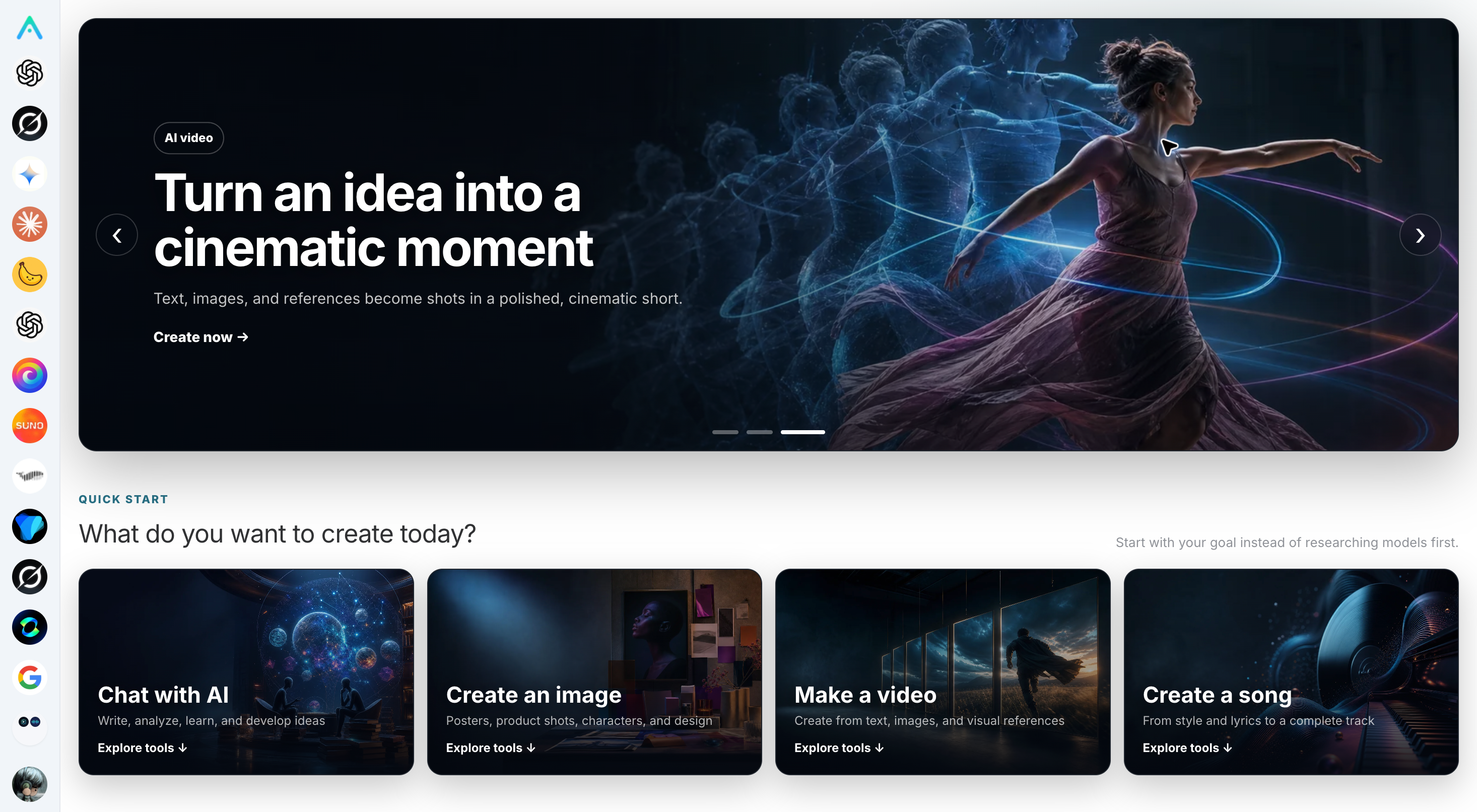
Ace Data Cloud Studio provides creators, operations, design, and business teams with unified AI chat, image, video, music, and automated video production tools. Users choose workflows based on their creative goals, without needing to repeatedly register, top up, and switch between multiple products first.
¶ Suitable Scenarios
- Content creation: writing, research, posters, covers, short videos, and background music;
- Marketing operations: product images, social media assets, campaign visuals, and brand content;
- Design exploration: reference image editing, style exploration, composition, and multi-version concepts;
- Business teams: complete cross-model, multi-step creative tasks using natural language;
- Developers and advanced users: configure API Keys, Connectors, Skills, or local tools in supported scenarios.
Specific available capabilities may vary with site configuration, region, account, and product version. The actual content currently displayed on the page shall prevail.
¶ How to Get Started
- Visit studio.acedata.cloud;
- Select the login method currently available on the page;
- Enter a tool from the creative goals on the homepage or the capability navigation on the left;
- Read the pricing, parameters, and content requirements of the current service;
- First validate the workflow with low-cost tasks, then proceed with high-resolution, long-video, or batch generation.
Billing units, processing time, and parameters vary across services. Before submitting, check the current page and usage records, and do not estimate prices based on historical screenshots.
¶ Core Workflows
¶ AI Chat
Used for writing, analysis, learning, programming, and multimodal discussions. Specific models, context capabilities, and tool support are subject to the current model selector.
¶ AI Image
Covers text-to-image generation, reference image editing, outpainting, style transfer, and visual design. Different image services each focus on dimensions, text rendering, character consistency, and editing capabilities.
¶ AI Video and Automated Video Production
Supports video creation driven by text, images, reference materials, or scripts. Automated video production workflows can combine scripts, visuals, voiceovers, subtitles, and music; for long tasks, pay attention to status queries, failure reasons, and final output completeness.
¶ AI Music
Supports generating songs from styles or lyrics, and continuing to edit or extend them based on the capabilities provided on the page. Before commercial use, independently verify content rights and the rules of the target platform.
¶ Connector, Skill, and Advanced Tools
Some accounts or sites can use Connectors, Skills, and local tools. These entries are constrained by the current product, permissions, and runtime environment, and are not enabled by default for all users or white-label sites.
¶ Web, Mobile, and Desktop
Studio Web is available at studio.acedata.cloud. The capabilities and site management entries of mobile and desktop versions may differ:
- White-label site management is displayed only to the current Site administrator in the Web version;
- Native mobile and desktop applications do not display all site operation settings;
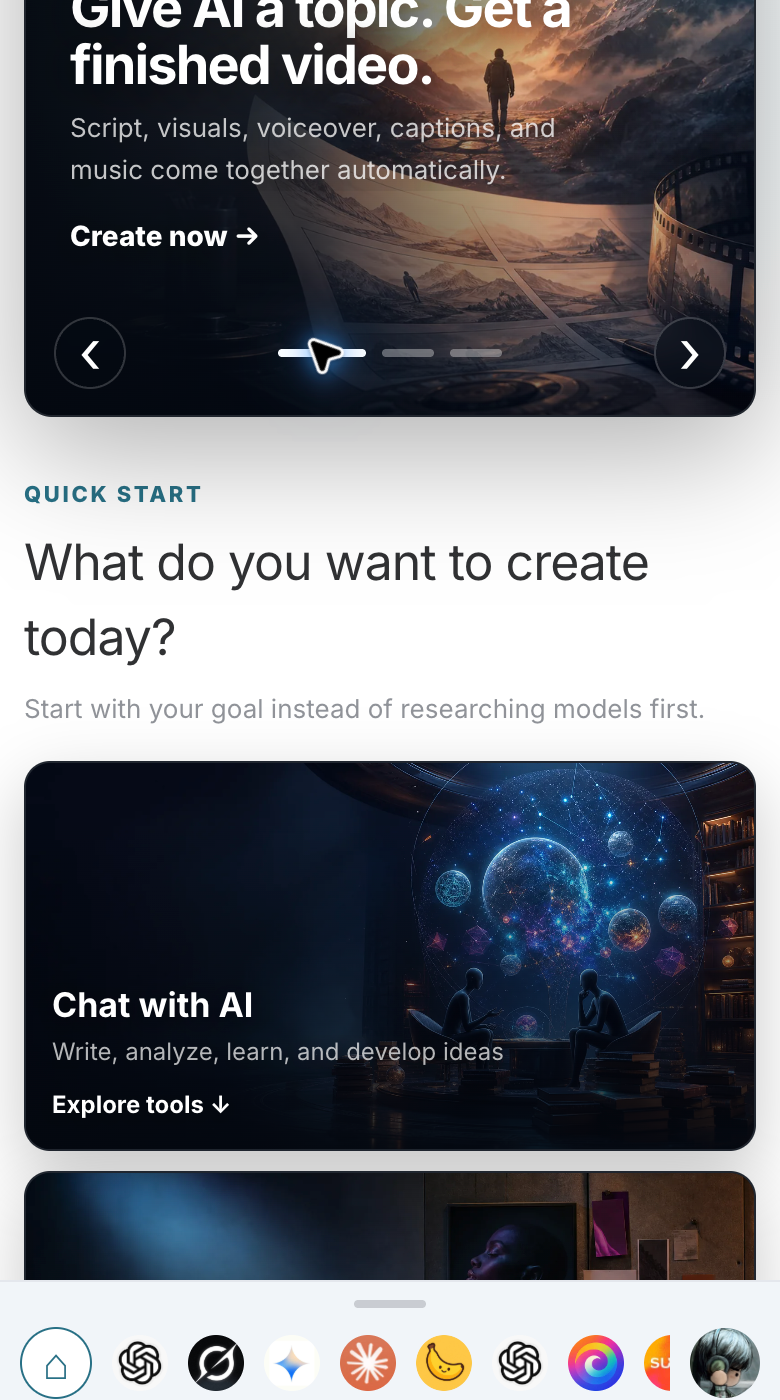
- Mobile widths use bottom capability navigation, while complex creation forms are more suitable for desktop browsers.
¶ Create Your Own Branded Subsite
If you need to operate Studio under your own name, Logo, page domain, capability catalog, and channel pricing, open the official Studio Web version:
User Avatar → Settings → My Sites
After creation, click Manage for the target subsite from “My Sites,” then configure branding, login, capabilities, pricing, banners, analytics, and custom domains.
Complete tutorials:
- White-Label Platform Overview
- Build a Studio White-Label Site from 0 to 1
- Studio Branding, Customer Service, SEO, and Login
- Studio Capability Catalog and Pricing
- Studio Custom Domains and Launch Acceptance
¶ White-Label and Distribution Boundaries
- White-label is a Site configuration on a shared platform, not an independent deployment or independent database;
- User accounts, balances, plans, and most assets belong to the shared system;
- Hiding top-ups, capabilities, or services is only page display control, not authorization isolation;
- Site markup is channel pricing in the normal white-label purchase process, not a mandatory tenant price for accounts across all entry points;
- Distribution earnings depend on valid orders, invitation relationships, tiers, refunds, and risk control, with no guarantee of fixed percentages, payout speed, or income figures.
¶ Usage Recommendations
- Important facts and generated content require manual review;
- Do not disclose passwords, API Keys, identity documents, or payment information in prompts, screenshots, chats, or tickets;
- Necessary authorization should be obtained for portraits, voices, trademarks, and copyrighted materials;
- Create samples first for high-cost tasks, and scale up only after confirming parameters;
- When abnormalities occur, record the time, service, status code, and publicly shareable request identifier, and do not submit complete tokens.
¶ Related Entry Points
¶ OAuth Authorization for Third-Party Websites on the Homepage
Website components can use standard OAuth redirects or component authorization with the current Studio account. Standard redirects open an authorization page through a third-party button, then return to its registered callback address; they do not require the Studio messaging protocol and do not automatically reuse the Studio login session. There is currently still a gap in continuing authorization after the first login in ordinary iframes; verify according to the integration documentation, or use a separate page/component authorization.
To use the current Studio account, enable OAuth in 「Settings → Homepage → Website Components」, and enter the third-party application ID and callback address. The website and callback address must use the same HTTPS origin, which must differ from the Studio origin. Do not enter the application secret in Settings. The third-party page must also implement the component messaging protocol; entering only a URL will not automatically complete the OAuth integration.
The component requests profile:read credentials:read, without including offline_access. After a logged-in visitor consents, the third party receives a one-time authorization code, uses its own PKCE verifier to exchange it for an OAuth token, and then reads items[*].token through https://platform.acedata.cloud/api/v1/credentials/?user_id=<id returned by UserInfo>&limit=100. No Key is provided when the user is not logged in or denies authorization.
For complete instructions, runnable standard redirect examples, the scope directory, and error handling, see the OAuth Integration Guide; applications using Studio sessions should also refer to the Component Message Example.
After permission to read the Key is granted, the third party can save and use it. The successful response from the current OAuth revocation endpoint does not mean that the JWT becomes invalid immediately, nor does it invalidate copied API Keys; the user needs to revoke or rotate that Key separately.