
OpenCode Integration with Google Search MCP
📘 Overview:OpenCode MCP Overview →
You are troubleshooting an OOM issue on a remote server using OpenCode and see an unfamiliar kernel log. Previously, you could only copy the error message, disconnect the terminal, switch to a local browser to search, and then switch back. After connecting to the Serp MCP Server, OpenCode can directly search Google in the terminal, completing the entire chain of "view logs → search information → modify code" without leaving the command line.
Google Search MCP is suitable for debugging production issues in OpenCode, conducting technology selection research, checking official documentation, finding GitHub issues, and any scenario that requires "searching the web to continue working."
¶ Obtain API Token
Before using the Google Search MCP Server, you need to prepare an Ace Data Cloud API Token. OpenCode and Claude Code share the same set of Tokens, and the acquisition process is the same:
- Open the Ace Data Cloud Console - Application List to obtain your API Token for backup.
- If you are not logged in or registered, you will be automatically redirected to the login page; after logging in or registering, you will automatically return to the current page.
- The first application will have a free quota available, allowing you to experience the Google Search MCP service for free.
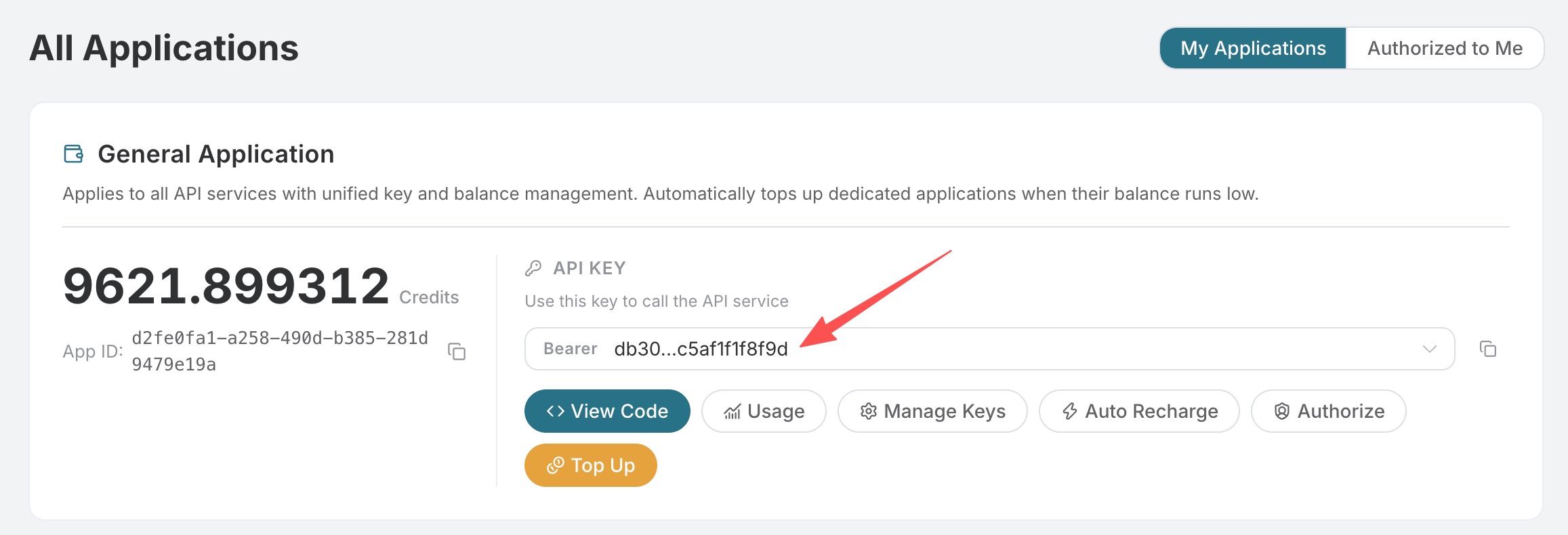
One Token can be used for all MCP Servers provided by Ace Data Cloud, and there is no need to apply separately for Google Search. The documentation and screenshots suggest displaying only the masked form, such as YOUR_ACEDATACLOUD_API_KEY, and do not paste the complete Token into public repositories, issues, screenshots, or chat records.
Want to use Claude Desktop / Claude.ai web version for direct OAuth one-click authorization? Please see the Claude.ai / Desktop tutorial for Google Search MCP.
¶ Configure OpenCode
OpenCode describes all MCP Servers in a single opencode.json file, which can be placed in two locations; choose one according to the "scope of effect" below. The field structure in both locations is exactly the same, with the only difference being priority.
It is strongly recommended to first write the Token to an environment variable:
export ACEDATACLOUD_API_KEY="replace with your real Token"
Then reference it in opencode.json using the {env:ACEDATACLOUD_API_KEY} placeholder to avoid writing the real Token into the file.
¶ Global: Shared by all projects
File location: ~/.config/opencode/opencode.json, suitable for "my own machine, configured once, usable by all projects."
{
  "$schema": "https://opencode.ai/config.json",
  "mcp": {
    "serp": {
      "type": "remote",
      "url": "https://serp.mcp.acedata.cloud/mcp",
      "enabled": true,
      "oauth": false,
      "headers": { "Authorization": "Bearer {env:ACEDATACLOUD_API_KEY}" }
    }
  }
}
⚠️
"oauth": falsecannot be omitted. AceData's MCP Server uses Bearer Token authentication and does not go through the OAuth process; OpenCode will automatically redirect 401 as an OAuth challenge by default, causingopencode mcp listto showSSE error: Non-200 status code (401). Explicitly declaring"oauth": falseallows OpenCode to call directly withAuthorization: Bearer ..., andopencode mcp debug serpwill also echoOAuth explicitly disabled, indicating it is effective.
¶ Project-level: Effective only for the current project
File location: opencode.json in the root directory of the current project, which will override the global configuration. Suitable for team sharing, single repository customization, or temporarily enabling a specific MCP in a certain project.
{
  "$schema": "https://opencode.ai/config.json",
  "mcp": {
    "serp": {
      "type": "remote",
      "url": "https://serp.mcp.acedata.cloud/mcp",
      "enabled": true,
      "oauth": false,
      "headers": { "Authorization": "Bearer {env:ACEDATACLOUD_API_KEY}" }
    }
  }
}
If the project-level opencode.json will be committed to Git, please ensure to use the {env:ACEDATACLOUD_API_KEY} placeholder instead of the real Token to avoid leakage.
💡 If the
.envin Shell is not explicitlyexported, you need to useset -a && source .env && set +ato pass the variables to the OpenCode process; otherwise,opencode debug configwill show"Authorization": "Bearer "(placeholder not resolved).
¶ Verify Connection
After configuration, run:
opencode mcp list
opencode mcp debug serp
Seeing serp connected indicates a successful handshake. If it fails, check whether ACEDATACLOUD_API_KEY has been exported, whether oauth is set to false, and whether Authorization includes the Bearer prefix. The model and tool schema will continue to change, so please select models that support native tool calls from the current directory.
¶ Typical Scenarios
After configuration, you can directly call using natural language in the OpenCode session without switching to /mcp:
Debugging Production Issues
Search how to solve nginx 502 bad gateway response header too large
Technology Selection Research
Search for the performance comparison of Python asynchronous ORM in 2025, SQLAlchemy 2.0 async vs Tortoise ORM
Check Official Documentation
Search the official documentation for Kubernetes CronJob concurrencyPolicy, the difference between Forbid and Replace
¶ Tool List
The table below lists the main tools; you can obtain the current complete list by using curl -X POST https://serp.mcp.acedata.cloud/mcp -H 'Authorization: Bearer <token>' -H 'Accept: application/json' -H 'Content-Type: application/json' --data '{"jsonrpc":"2.0","id":1,"method":"tools/list"}':
| Tool | Description |
|---|---|
| serp_google_search | Google web search, supports specifying country, language, and time range |
| serp_google_images | Google image search |
| serp_google_news | Google news search |
| serp_google_videos | Google video search |
| serp_google_maps / serp_google_places | Map / local business search |