
OpenCode Integration with Seedance MCP
📘 Overview:OpenCode MCP Overview →
Seedance performs particularly well in "short videos / vertical materials / action performances," providing complete videos with audio in one go, making it very suitable for direct use as social media content. After connecting the Seedance MCP Server in OpenCode, you can generate animated videos directly from a single sentence of requirements, eliminating the intermediate steps of editing and voiceover.
Seedance MCP is suitable for creating Reels / Douyin / Xiaohongshu short videos, product demo animations, technical sharing opening clips, and other "short and impactful" video scenarios.
¶ Obtain API Token
Before using the Seedance MCP Server, you need to prepare an Ace Data Cloud API Token. OpenCode and Claude Code share the same set of tokens, and the acquisition process is the same:
- Open the Ace Data Cloud Console - Application List to obtain your API Token for backup.
- If you are not logged in or registered, you will be automatically redirected to the login page; after logging in or registering, you will be automatically returned to the current page.
- The first application will come with a free quota, allowing you to experience the Seedance MCP service for free.
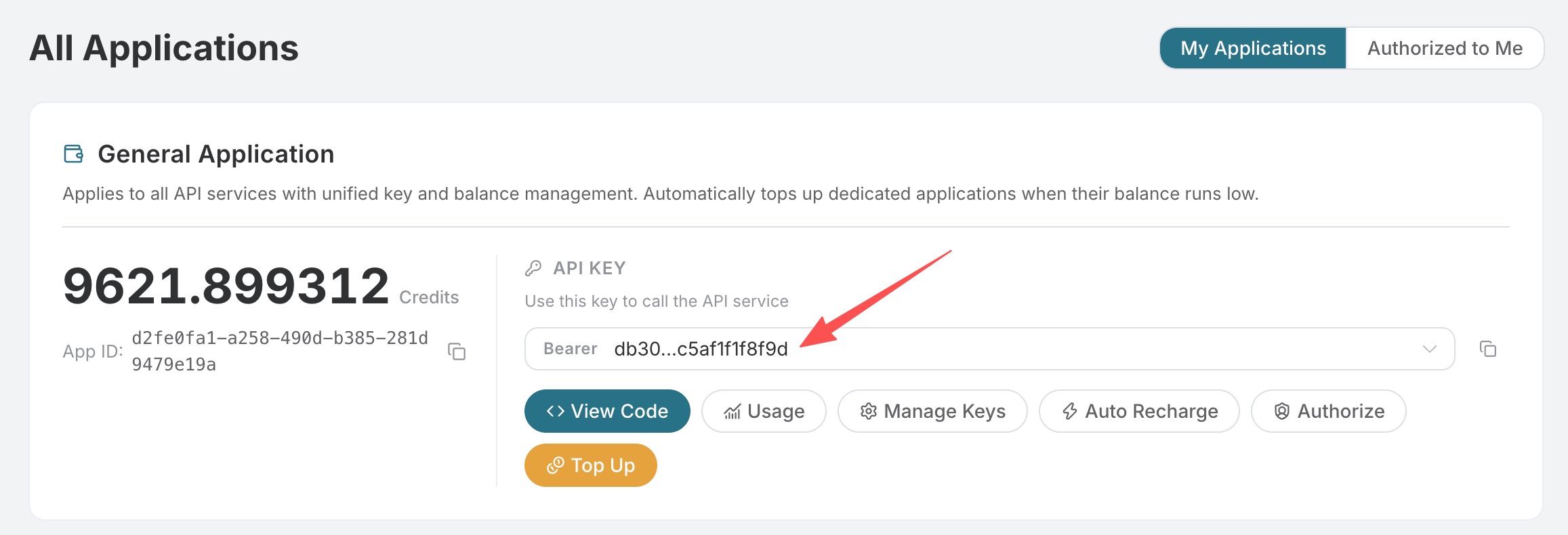
One token can be used for all MCP Servers provided by Ace Data Cloud, and there is no need to apply separately for Seedance. The documentation and screenshots suggest displaying only a desensitized format, such as YOUR_ACEDATACLOUD_API_KEY, and do not paste the complete token into public repositories, issues, screenshots, or chat records.
Want to use Claude Desktop / Claude.ai web version for direct OAuth one-click authorization? Please see the Claude.ai / Desktop tutorial for Seedance MCP.
¶ Configure OpenCode
OpenCode describes all MCP Servers in a single opencode.json file, which can be placed in two locations; choose one according to the "scope of application" below. The field structure in both locations is exactly the same, with the only difference being priority.
It is strongly recommended to first write the token to an environment variable:
export ACEDATACLOUD_API_KEY="replace with your real token"
Then reference it in opencode.json using the {env:ACEDATACLOUD_API_KEY} placeholder to avoid writing the real token into the file.
¶ Global: Shared by all projects
File location: ~/.config/opencode/opencode.json, suitable for "my own machine, configured once, usable by all projects."
{
  "$schema": "https://opencode.ai/config.json",
  "mcp": {
    "seedance": {
      "type": "remote",
      "url": "https://seedance.mcp.acedata.cloud/mcp",
      "enabled": true,
      "oauth": false,
      "headers": { "Authorization": "Bearer {env:ACEDATACLOUD_API_KEY}" }
    }
  }
}
⚠️
"oauth": falsecannot be omitted. AceData's MCP Server uses Bearer Token authentication and does not go through the OAuth process; OpenCode will automatically redirect 401 as an OAuth challenge, resulting inopencode mcp listshowingSSE error: Non-200 status code (401). Explicitly declaring"oauth": falseallows OpenCode to call directly withAuthorization: Bearer ..., andopencode mcp debug seedancewill also echoOAuth explicitly disabled, indicating it is effective.
¶ Project-level: Effective only for the current project
File location: opencode.json in the root directory of the current project, which will override the global configuration. Suitable for team sharing, single repository customization, or temporarily enabling a specific MCP in a certain project.
{
  "$schema": "https://opencode.ai/config.json",
  "mcp": {
    "seedance": {
      "type": "remote",
      "url": "https://seedance.mcp.acedata.cloud/mcp",
      "enabled": true,
      "oauth": false,
      "headers": { "Authorization": "Bearer {env:ACEDATACLOUD_API_KEY}" }
    }
  }
}
If the project-level opencode.json will be committed to Git, please ensure to use the {env:ACEDATACLOUD_API_KEY} placeholder instead of the real token to avoid leakage.
💡 If the
.envin Shell is not explicitlyexported, you need to useset -a && source .env && set +ato pass the variables to the OpenCode process; otherwise,opencode debug configwill show"Authorization": "Bearer "(the placeholder is not resolved).
¶ Verify Connection
After configuration, run:
opencode mcp list
opencode mcp debug seedance
Seeing seedance connected indicates a successful handshake. If it fails, check whether ACEDATACLOUD_API_KEY has been exported, whether oauth is set to false, and whether Authorization includes the Bearer prefix. The model and tool schema will continue to change, so please select models that support native tool calls from the current directory.
¶ Typical Scenarios
After configuration, you can directly call using natural language in the OpenCode session without switching to /mcp:
Text to generate short video
Generate a vertical short video: a girl turns under a cherry blossom tree, slow motion, beautiful light and shadow
Image to video
Use this image as a cover, generate a video with the camera slowly zooming in
Generate video intro
Generate a 3-second video intro: a glowing code symbol </> transitions from blurry to clear, with particle effects in the background, in a tech blue tone
¶ Tool List
The table below lists the main tools; you can obtain the current complete list by using curl -X POST https://seedance.mcp.acedata.cloud/mcp -H 'Authorization: Bearer <token>' -H 'Accept: application/json' -H 'Content-Type: application/json' --data '{"jsonrpc":"2.0","id":1,"method":"tools/list"}':
| Tool | Description |
|---|---|
| seedance_generate_video | Text to video generation |
| seedance_generate_video_from_image | Image to video generation |