
Long-term Content Acquisition: Let One Creation Continuously Generate Exposure
Transforming real usage experiences into articles, videos, and open-source projects can continue to gain exposure after publication, but traffic, registration, purchases, repurchases, and commissions are not guaranteed. Long-term content still requires continuous updates, account maintenance, customer support, and platform compliance.
¶ 1. Why "Content Accumulation" is the Optimal Solution for Distribution
Most people rely on "posting in Moments, mass messaging" for distribution, which is useful, but essentially it is one-time traffic: post once, reach once, and then it's gone.
Content accumulation is different:
- A Zhihu article, once indexed by search, can be found by people every day.
- A GitHub open-source project that receives stars/forks continues to gain exposure.
- A technical tutorial written years ago is still being viewed today.
Content can only generate commissions when it continuously gains exposure, and readers register through effective invitation relationships and generate orders that comply with the rules. The invitation window, attribution, and settlement are based on the promotion methods and commission rules and backend records.
So, a good piece of content you write today will continue to work for you as long as it is still being seen and still brings registrations.
¶ 2. First Confirm the Commission Rules
Commissions only come from valid orders that comply with the current rules. Levels, ratios, invitation attribution, confirmation periods, and withdrawal conditions are based on the promotion methods and commission rules and what is currently displayed in the distribution backend; refunds, risk control, order status, and existing invitation relationships may all affect the final result.
¶ 3. Content Strategies for Various Platforms
¶ 1. Zhihu: A Gold Mine for Long-tail Searches
Zhihu content has high weight in searches and a long lifecycle.
Recommended Topics:
- "What are some good AI painting APIs?"
- "Comparison between DeepSeek API and OpenAI API, which is more cost-effective?"
- "How to integrate Suno AI music generation into your product?"
Writing Points: First, answer the question authentically, showcase usage experience, include code examples and effect screenshots, and naturally guide at the end with "If you want to try, you can register at Ace Data Cloud" (with your invitation link).
Zhihu is also one of the platforms that supports AI automatic publishing (see Section 5), allowing for higher accumulation efficiency.
¶ 2. CSDN / Juejin: The Main Battlefield for Technical Tutorials
Most users are developers, making it a precise audience for API products.
High Conversion Topics:
- "Integrate gpt-image-2 in 5 minutes to achieve AI image generation functionality"
- "Complete tutorial on using Python to call Suno API for music generation"
- "One API Key to call GPT / Claude / Gemini: A comprehensive guide to OpenAI compatible interfaces"
Content Template: Pain point introduction → Solution → Complete runnable code → Effect demonstration → Registration guidance (with link). People who read technical tutorials are likely to be those who want to use APIs, making conversion naturally precise.
Juejin and CSDN are also on the list of platforms that support automatic publishing.
¶ 3. GitHub: Long-term Assets of Open-source Projects
Many people overlook this, but the results are very good.
Project Directions: Write an SDK/command-line tool that calls the API Platform, create an AI application demo (AI wallpaper generator, AI music workstation), or maintain an "Awesome AI APIs" list. Naturally guide users to register with your invitation link in the README. A project that continuously receives stars may continue to gain exposure and registrations.
¶ 4. Bilibili / YouTube: Trust Multiplier for Videos
The trust level of videos is usually higher than that of text:
- "Build your AI chatbot in 3 minutes"
- "Complete process of generating AI videos using API"
Place the invitation link in the video description; high-quality videos can maintain long-tail traffic for a long time.
¶ 5. Medium / Dev.to: Targeting International Developers
If your English is decent, competition in overseas tech communities is often lower, and the average order value is usually higher:
- "How to build an AI app using Ace Data Cloud APIs"
- "Best alternatives to OpenAI API for your project"
¶ 4. Use Scheduled Tasks to Assist Content Maintenance
Studio can connect to community accounts you have the authority to manage, and then use scheduled tasks to generate drafts or call authorized publishing skills as planned. Execution is affected by credentials, balance, review, and third-party platform policies, requiring continuous checks.
Step 1 · Connect Your Account. Studio chat input box → "Add Content (+)" → "Connect" → Open https://studio.acedata.cloud/console/connectors.
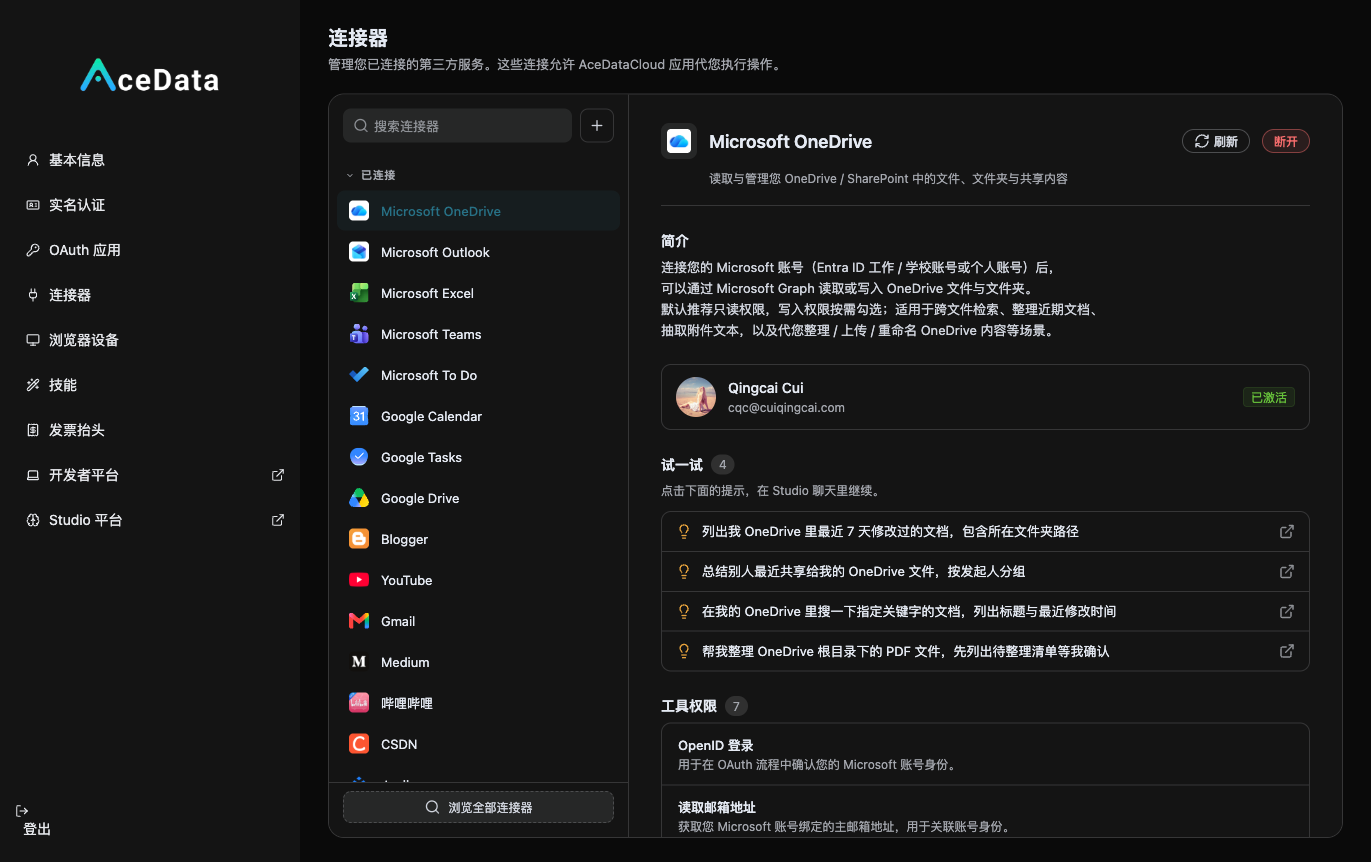
Currently, platforms with real automatic publishing capabilities include: Zhihu (can search articles, view statistics of your articles, publish articles, answer questions), Juejin (list/view your article data, publish articles), Xiaohongshu (connects to local browser operations, can search, publish images/videos/long articles, schedule), as well as Bilibili, CSDN, Medium, Weibo, WordPress, X, etc.
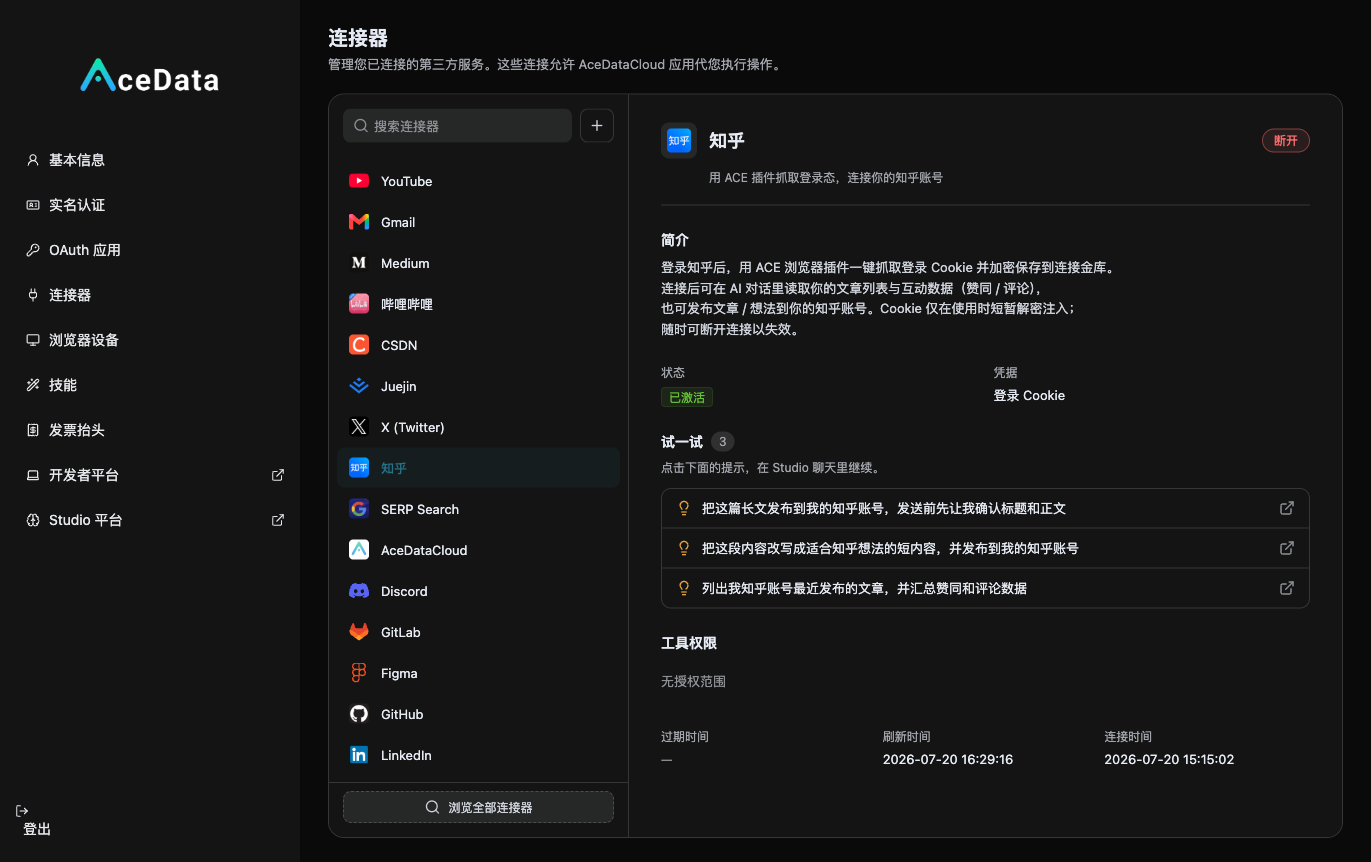
Note: Today's headlines, Baijiahao, and Facebook currently only have connection capabilities, without automatic publishing capabilities, so do not include them in the "AI automatic publishing" plan.
Step 2 · Set Up Scheduled Tasks. Open https://studio.acedata.cloud/chatgpt/scheduled, create a new task: set the trigger time (cron/interval/one-time), write the prompt, such as "Search for today's hot topics in the AI field → Use gpt-image-2 to create a cover image → Write it into a Zhihu article and publish."
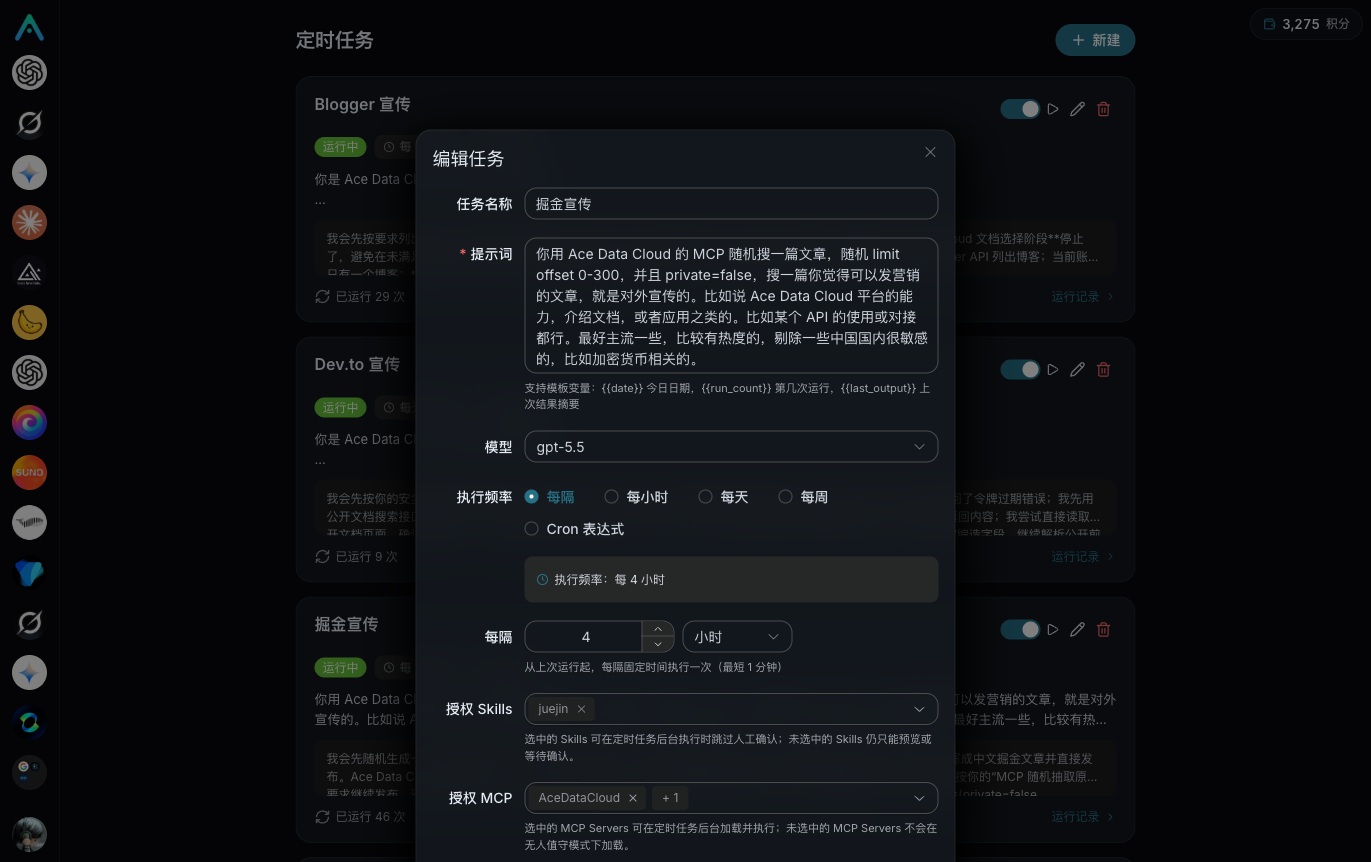
Key Pitfall: Unattended publishing must include the skills used (e.g., Zhihu) in the task's allowed_skills whitelist, otherwise it will fail with skill_not_active. Once configured, the task will run automatically on schedule.
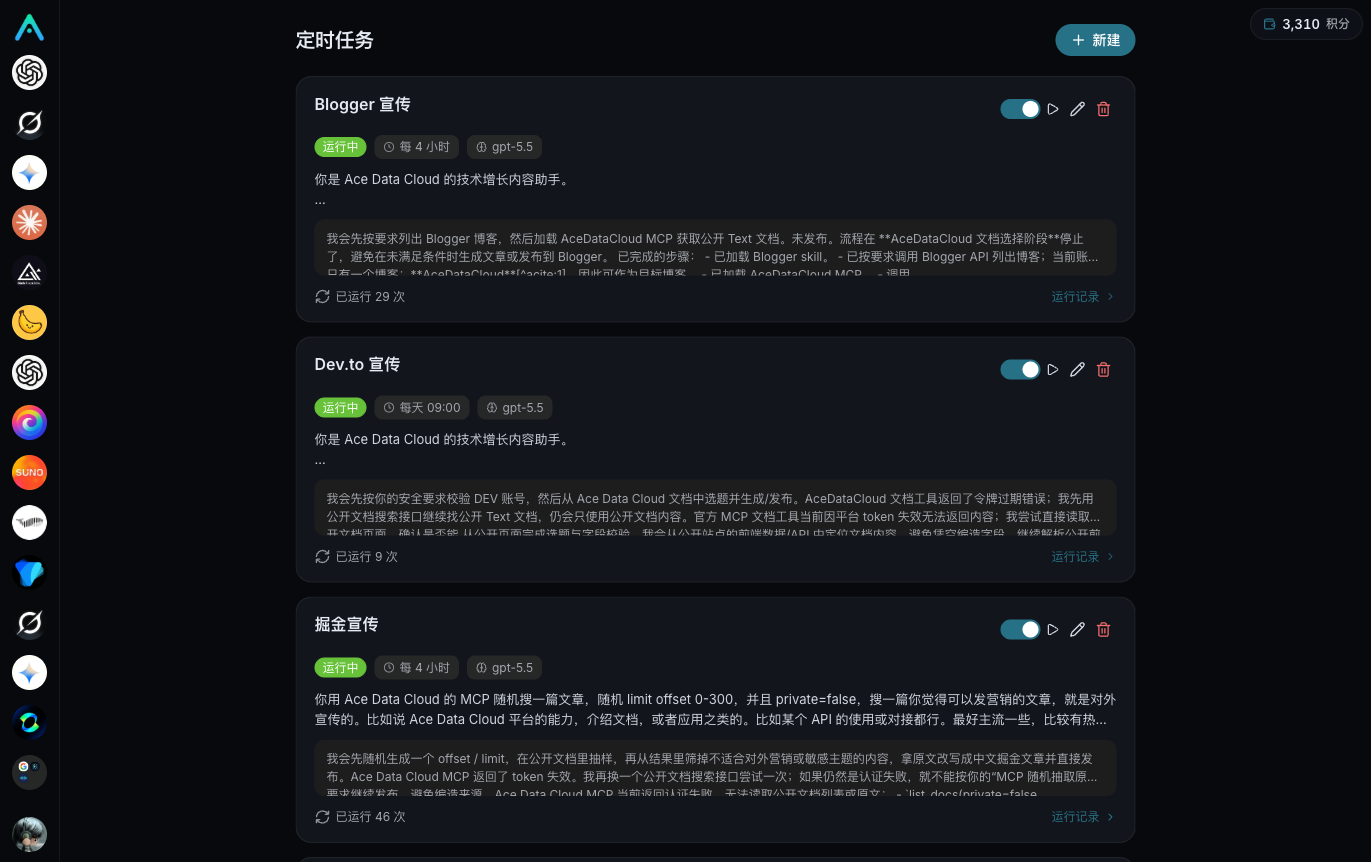
Tasks can reduce repetitive operations but cannot replace fact-checking, content review, and account maintenance. It is recommended to prioritize saving drafts and regularly check the operation history.
¶ 5. Compound Effect: Why You Should Persist in Accumulation
The value of content accumulation lies in overlapping: while new content brings new traffic, old content continues to generate volume.
Using an illustrative deduction (the numbers are only indicative of the mechanism, not a revenue commitment): suppose you produce 2 pieces of content each month that can continuously generate volume. As the articles accumulate, the active users and cumulative consumption under your name also grow, and the tier ratio will naturally rise from L1 upwards. The most crucial point is: even if updates decrease for a certain period, historical content may still continue to gain exposure. This is the fundamental difference between accumulation and the "post once, lose once" approach of social media.
To make this compound interest work, there is only one prerequisite: the content must be genuine and useful. Exaggeration and fabrication can trick people into clicking once, but cannot deceive them into long-term repurchases—while distribution commissions precisely rely on long-term repurchases.
¶ Six, Start Immediately
- Open the distribution backend to receive your exclusive invitation link.
- Today, choose a platform you are familiar with and write a genuine usage article.
- Connect your account and set up low-frequency scheduled tasks, leaving repetitive steps to AI while retaining manual review.
- Don’t pursue perfection; send it out first, and optimize later.
Treat each piece of content as a reusable customer acquisition experiment: record results, continuously update, and retain truly effective themes and channels.
Start 👉 https://platform.acedata.cloud
If you have questions, contact customer service 👉 https://platform.acedata.cloud/support