
HappyHorse Videos API Integration Guide
This document introduces how to integrate with the HappyHorse Videos API. This API supports text-to-video, first-frame image-to-video, reference image-to-video, and video editing through the unified /happyhorse/videos endpoint and the action parameter.
¶ Application Process
To use the HappyHorse Videos API, first go to the Ace Data Cloud Console to obtain your API Token and keep it for later use.
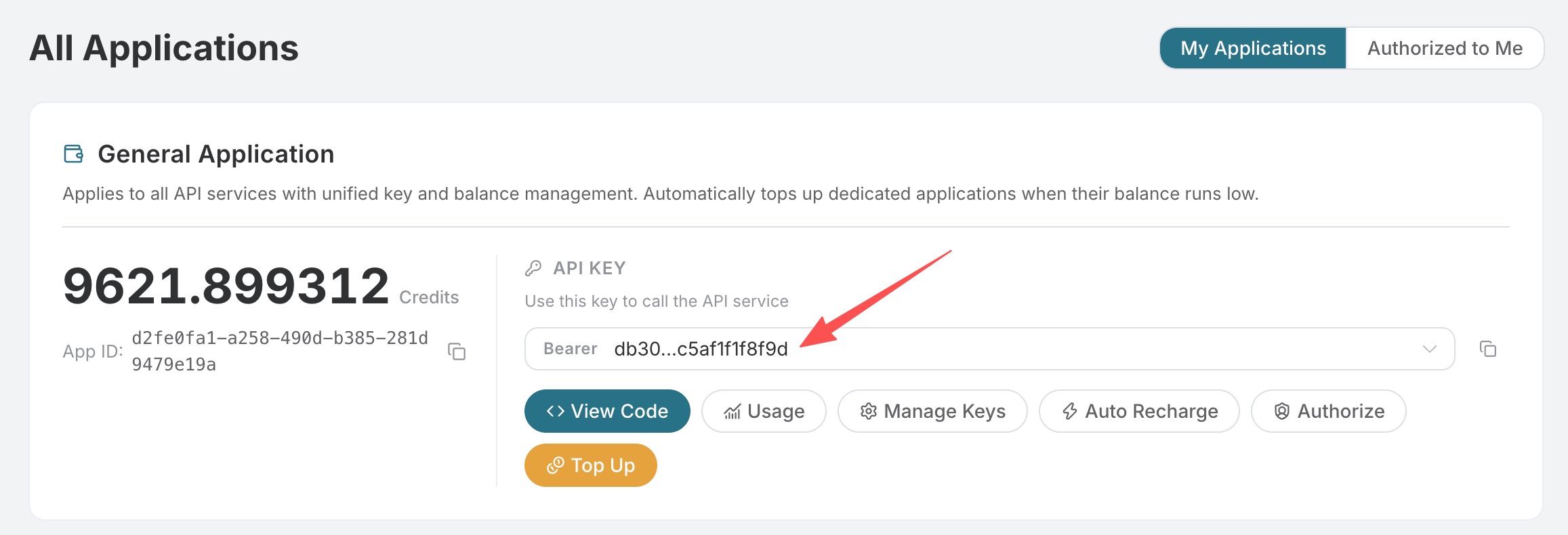
If you have not logged in or registered yet, you will be automatically redirected to the login page and invited to register and log in. After completion, you will automatically return to the current page.
One API Token can be used to call all platform services, with no need to apply separately for each service. Your first application includes free credits for a free trial; when credits are insufficient, you can top up your general balance in the Console.
📘 Full documentation: HappyHorse Videos API →
¶ Action Types
action determines the generation mode for this request:
generate: Text-to-video, the default action, supportshappyhorse-1.0-t2vandhappyhorse-1.1-t2v, and requiresprompt.image_to_video: First-frame image-to-video, supportshappyhorse-1.0-i2vandhappyhorse-1.1-i2v, and requiresimage_url.reference_to_video: Reference image-to-video, supportshappyhorse-1.0-r2vandhappyhorse-1.1-r2v, and requirespromptand 1–9image_urls.video_edit: Video editing, supportshappyhorse-1.0-video-edit, and requirespromptandvideo_url. You may additionally provide 0–5 reference images inimage_urls.
Each action uses the 1.1 model by default; video_edit currently only has happyhorse-1.0-video-edit.
¶ Basic Usage
Text-to-video only requires prompt; you can also specify parameters such as resolution, ratio, and duration:
{
  "action": "generate",
  "model": "happyhorse-1.1-t2v",
  "prompt": "A cinematic white horse lifts its head, the mane moves gently in the sunrise wind, slow camera push in, warm film lighting",
  "resolution": "720P",
  "ratio": "16:9",
  "duration": 5
}
An example response is as follows:
{
  "success": true,
  "task_id": "27837f92-d1c1-4db4-ad9a-4e6e81d9f6c1",
  "trace_id": "6071ab5e-2f37-46f0-9e07-f1e378112e69",
  "data": [
    {
      "id": "9650580f-6d9e-4bc1-823a-29011790c5cb",
      "video_url": "https://cdn.acedata.cloud/assets/examples/happyhorse/27837f92-d1c1-4db4-ad9a-4e6e81d9f6c1-2c108ce23554.mp4",
      "state": "succeeded",
      "duration": 5,
      "resolution": "720P",
      "ratio": null
    }
  ]
}
Field descriptions:
success: Whether this request was successful.task_id: The task ID on the Ace Data Cloud side, which can be used to query the task status.trace_id: The trace ID for this request, used for troubleshooting.data: Video result list.id: The task ID on the HappyHorse side.video_url: The CDN URL of the generated video.state: Task status, with possible valuespending/succeeded/error.duration: The billable video duration, in seconds; forvideo_edit, it is the combined duration of the input and output videos.resolution: Output resolution.ratio: Output aspect ratio.
The corresponding CURL code is as follows:
curl -X POST 'https://api.acedata.cloud/happyhorse/videos' \
-H 'authorization: Bearer ${bearer_token}' \
-H 'accept: application/json' \
-H 'content-type: application/json' \
-d '{
  "action": "generate",
  "model": "happyhorse-1.1-t2v",
  "prompt": "A cinematic white horse lifts its head, the mane moves gently in the sunrise wind, slow camera push in, warm film lighting",
  "resolution": "720P",
  "ratio": "16:9",
  "duration": 5
}'
The corresponding Python code is as follows:
import requests

url = "https://api.acedata.cloud/happyhorse/videos"

headers = {
    "accept": "application/json",
    "authorization": "Bearer {token}",
    "content-type": "application/json",
}

payload = {
    "action": "generate",
    "model": "happyhorse-1.1-t2v",
    "prompt": "A cinematic white horse lifts its head, the mane moves gently in the sunrise wind, slow camera push in, warm film lighting",
    "resolution": "720P",
    "ratio": "16:9",
    "duration": 5,
}

response = requests.post(url, json=payload, headers=headers)
print(response.text)
¶ First-Frame Image-to-Video
When using image_to_video, image_url will be used as the first frame of the video. The output aspect ratio will follow the first-frame image as closely as possible, so this action does not require ratio.
{
  "action": "image_to_video",
  "model": "happyhorse-1.1-i2v",
  "image_url": "https://cdn.acedata.cloud/b1c82e4937.png",
  "prompt": "A cinematic white horse lifts its head, the mane moves gently in the sunrise wind, slow camera push in, warm film lighting",
  "resolution": "1080P",
  "duration": 5
}
¶ Reference Image-to-Video
When using reference_to_video, image_urls can include 1–9 reference images. In the prompt, you can use character1, character2, and so on to reference images in their corresponding order.
{
  "action": "reference_to_video",
  "model": "happyhorse-1.1-r2v",
  "prompt": "character1 walks forward through a sunrise meadow with the warm leather and gold trim style from character2",
  "image_urls": [
    "https://cdn.acedata.cloud/b1c82e4937.png",
    "https://cdn.acedata.cloud/eb75d88a3f.png"
  ],
  "resolution": "720P",
  "ratio": "16:9",
  "duration": 5
}
¶ Video Editing
When using video_edit, you must provide the video to be edited, video_url, and the editing intent, prompt. Optional image_urls will be used as reference images, for example, for outfit changes, style transfer, or partial replacement. audio_setting can be either auto or origin, where origin means retaining the original video audio.
{
  "action": "video_edit",
  "model": "happyhorse-1.0-video-edit",
  "prompt": "Apply the warm leather and gold trim style from the reference image while preserving the original camera motion",
  "video_url": "https://cdn.acedata.cloud/assets/examples/happyhorse/27837f92-d1c1-4db4-ad9a-4e6e81d9f6c1-2c108ce23554.mp4",
  "image_urls": [
    "https://cdn.acedata.cloud/eb75d88a3f.png"
  ],
  "resolution": "720P",
  "audio_setting": "auto"
}
¶ Asynchronous Callback
Video generation requires a certain amount of processing time. If you do not want to keep a long connection open while waiting, you can pass callback_url, and the API will immediately return task_id. After the task is completed, the final result will be POSTed to this address:
{
  "action": "generate",
  "prompt": "A horse running through a snowy forest",
  "duration": 5,
  "callback_url": "https://your-domain.com/callback/happyhorse"
}
The immediately returned result is as follows:
{
  "task_id": "b8976e18-32dc-4718-9ed8-1ea090fcb6ea"
}
If you only want to poll and do not need a callback, you can also pass "async": true, and then query the task result through the HappyHorse Tasks API.
¶ Billing Information
HappyHorse charges based on the output video duration in seconds and resolution:
720P: As low as approximately $0.105 / second.1080P: As low as approximately $0.18 / second.video_edit: Charged based on the combined duration of the input video and output video. The actual billable duration is subject to the statistics after the task is completed.
Failed tasks are not charged and do not consume free quota.
¶ Error Handling
When there is a problem with the request, the API will return the corresponding error code and description. Common ones are as follows:
400: Incorrect request parameters, for example, the action does not match the model,prompt/image_url/video_urlis missing, ordurationis outside the range of 3–15 seconds.401: Authentication failed; the token is invalid or does not match the API.403: Insufficient balance, or the prompt was rejected due to content moderation.429: Requests are too frequent and rate limiting has been triggered. Please try again later.500: Internal server error or generation failed.