
Claude Code Integration with Luma MCP
📘 Overview:Claude Code MCP Overview →
You have finished writing a README in Claude Code and want to add a dynamic demonstration effect. Opening a browser to use video tools disrupts the flow—connect to the Luma MCP Server and handle it directly in the terminal without leaving the command line.
¶ Obtain API Token
Before using the Luma MCP Server, you need to prepare an Ace Data Cloud API Token. The method of obtaining it is consistent with the Claude Code VS Code configuration tutorial:
- Open the Ace Data Cloud Console - Application List to get your API Token for backup.
- If you are not logged in or registered, you will be automatically redirected to the login page; after logging in or registering, you will automatically return to the current page.
- The first application will grant a free quota, allowing you to experience the Claude Code MCP service for free.
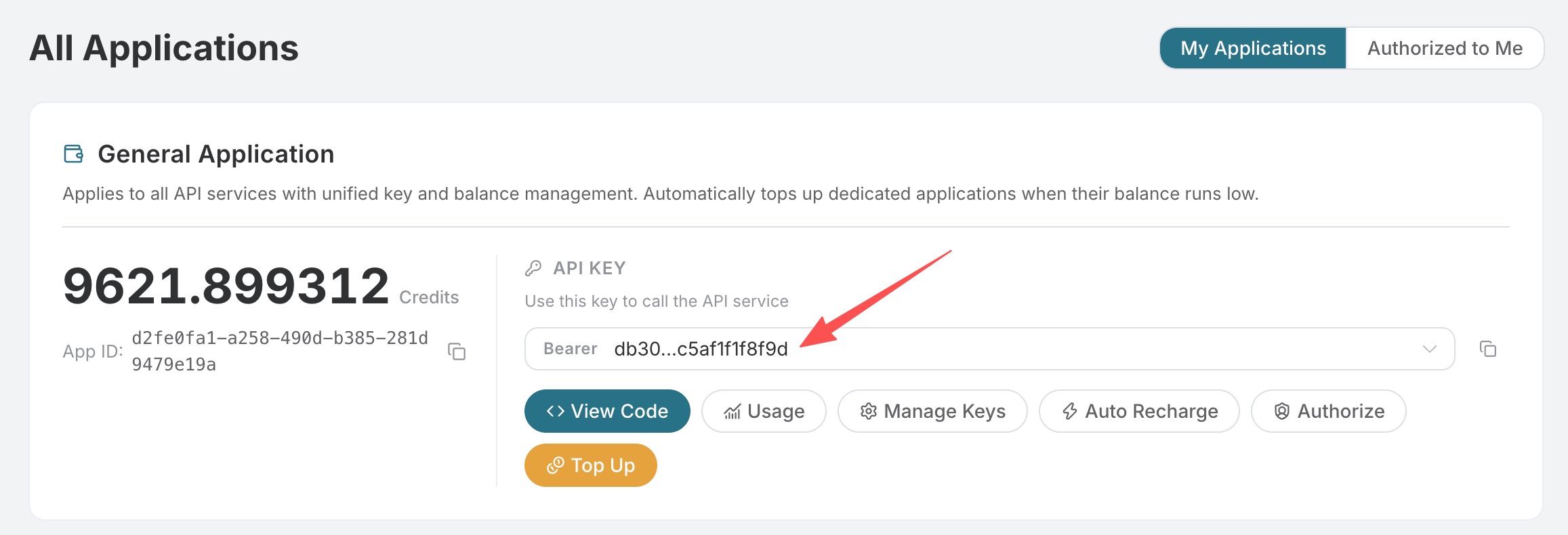
One Token can be used for all MCP Servers provided by Ace Data Cloud, without needing to apply separately for Luma. The documentation and screenshots suggest displaying only the masked form, such as YOUR_ACEDATACLOUD_API_KEY, and do not paste the complete Token into public repositories, Issues, screenshots, or chat records.
Using the web version of claude.ai or Claude Desktop? They support OAuth one-click authorization, eliminating the need to manually fill in the Token. For details, see the Claude.ai / Desktop tutorial for Luma MCP.
¶ Configure Claude Code
Choose one from the following three options. -H must be uppercase; the lowercase -h is --help; please replace the Token after Authorization with the actual value you copied from the console.
¶ For current project only: local
Suitable for trial use, the configuration is bound only to the project directory where you run the command. Claude Code will write the record into the local ~/.claude.json, along with the current project path.
claude mcp add luma --transport http https://luma.mcp.acedata.cloud/mcp \
  -H "Authorization: Bearer YOUR_ACEDATACLOUD_API_KEY" \
  -s local
¶ Usable for all projects: user
Suitable for frequent use of Luma MCP across multiple projects. The configuration is written into the local ~/.claude.json user-level configuration, which will be visible in any project opened in Claude Code thereafter.
claude mcp add luma --transport http https://luma.mcp.acedata.cloud/mcp \
  -H "Authorization: Bearer YOUR_ACEDATACLOUD_API_KEY" \
  -s user
¶ Shared with the project: project
Suitable for team projects. The configuration is written into the .mcp.json in the current project root directory, which can be submitted to a private repository for teammates to reuse; do not submit the real Token to public repositories, and it is recommended to change it to an environment variable placeholder or have each person add it locally.
claude mcp add luma --transport http https://luma.mcp.acedata.cloud/mcp \
  -H "Authorization: Bearer YOUR_ACEDATACLOUD_API_KEY" \
  -s project
When the project-level configuration is read by Claude Code for the first time, it may display Pending approval, and you need to confirm trust in this project configuration within the Claude Code session. This is a normal security prompt.
¶ Verify Connection
After configuration, run:
claude mcp list
Seeing luma display ✓ Connected indicates a successful handshake. If it fails, check the Token, service URL, and configuration scope; do not judge the current status based on historical client versions or fixed tool counts.
¶ Practical Scenarios
After configuration, return to the Claude Code session and directly use natural language to call Luma:
Finished the project and want to make a promotional video
Post it on Twitter or Product Hunt:
Generate a video: a laptop screen displaying code, with a steaming cup of hot coffee beside it, in soft morning light
Make the design draft come alive
luma_generate_video_from_image accepts a reference image to turn a static screenshot into a dynamic display:
Use this UI screenshot as a reference to generate a video, adding subtle animations to the elements on the interface
Video is too short, continue
luma_extend_video continues from the end, maintaining the same style:
Extend this video for another 10 seconds, keeping the same style
¶ Tool List
| Tool | Description |
|---|---|
| luma_generate_video | Text to video generation |
| luma_generate_video_from_image | Generate video from reference image |
| luma_extend_video | Video extension |