
¶ 1. Why Does AI Need More Than Just More Text?
“This solution is not suitable for a production environment.”
If AI only sees this sentence, it is difficult for it to determine what exactly it is rejecting: a technology, a deployment method, or an implementation approach under specific conditions?
But if the preceding context is added, the meaning may become much clearer:
Question: I want to build a file-sharing service. Can I directly store uploaded files inside the container?
Answer: It is fine for short-term validation, but you need to consider data retention after the container is rebuilt.
Follow-up question: What if it is to be officially launched?
Additional note: Then you need to further consider persistence, backups, and scaling. You cannot simply continue using the approach from the prototype stage.
The above is an illustrative dialogue explaining the role of context, not an original record from the dataset.
In this example, the knowledge truly worth extracting is not simply “yes” or “no,” but under what conditions a solution works, and under what circumstances it needs to be adjusted.
This is also the unique value of community discussion data: it not only carries conclusions, but also records the background in which questions were raised, the trade-offs among different solutions, and the process through which viewpoints were supplemented and revised. To enable AI to make better use of community content, it is not enough to split posts and comments into separate pieces of text; it is also necessary to preserve the relationships among them as much as possible.
¶ 2. Understanding the Ace Data Cloud Reddit Dataset
Ace Data Cloud’s Reddit Posts & Comments dataset organizes content around forum posts, comments, and multi-level replies, preserving their communities and parent-child relationships, and supporting the selection of data ranges based on discussion topics and content conditions.[1]
What it focuses on is not only “what text exists,” but also:
- Which discussion community this content belongs to;
- What question the original post raised;
- Whether a comment responds to the post or to another comment;
- How subsequent replies supplement, question, or extend earlier viewpoints.
¶ Data Scale and Public Preview
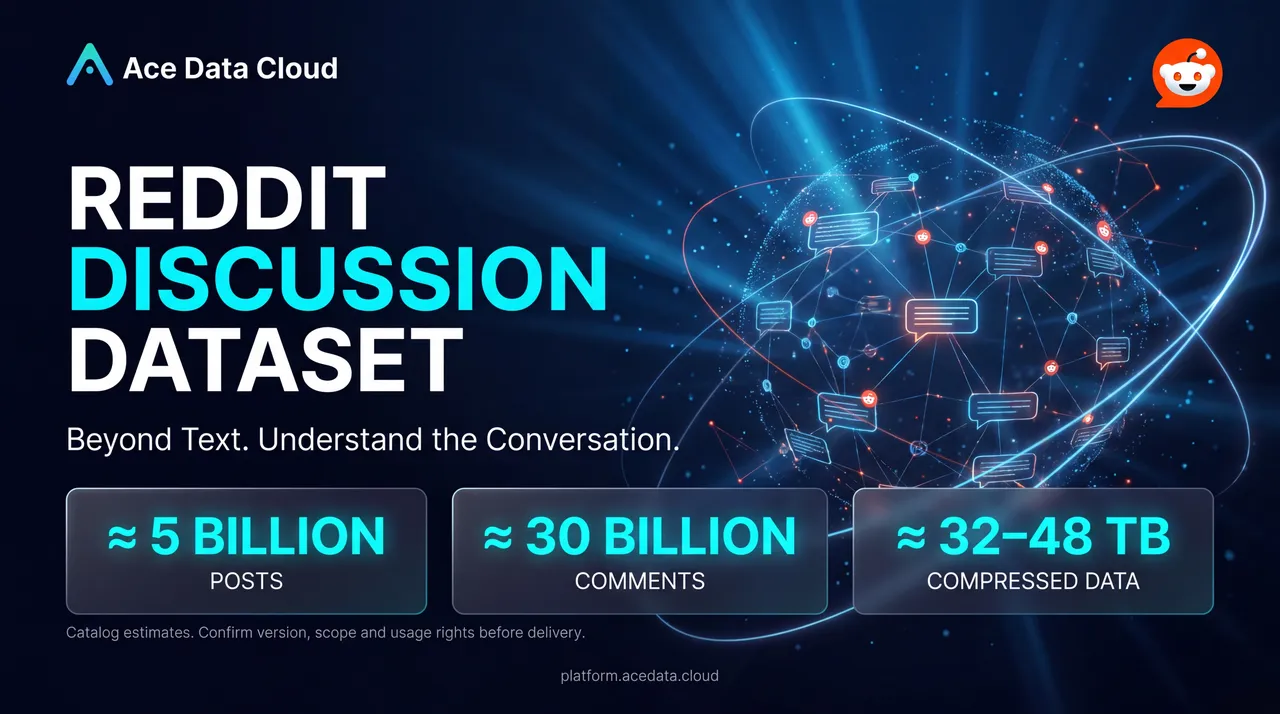
The directory registration information displayed on the service page is as follows. These figures use the directory-scale definition; the actual deliverable quantity, volume, and scope still need to be confirmed according to the specific version.[1]
| Dimension | Directory Description |
|---|---|
| Post scale | Approximately 5 billion records |
| Comment scale | Approximately 30 billion records |
| Compressed size | Approximately 32–48 TB |
| Public preview | 5 preview records, without image excerpts |
| Supporting materials | Field reference and Chinese-English README |
| Access method | First review samples, then confirm version, scope, license, and quotation |
For specific projects, the more important question is not “how much data is there in total,” but rather: how much data is relevant to the business, contains valid content, has reconstructable relationships, and is licensed for the intended use.
For example, when building a Q&A assistant for Web development, one should usually prioritize topic coverage and answer quality in relevant communities, rather than directly pursuing the largest possible data volume.
¶ 3. Data Structure: Putting Text Back Into Its Discussion Context
This dataset can be understood from three levels: posts, comments, and reply relationships.

Conceptual diagram: Only by preserving discussion relationships can context be understood more effectively.
¶ 1. Posts: Understanding Where the Question Begins
Posts usually provide the topic and initial background of a discussion. The field reference in the public sample package lists fields such as post ID, community, time, title, body text, tags, and original links.[2]
| Field | Meaning | Application Value |
|---|---|---|
post.id |
Post identifier | Deduplication, indexing, and comment association |
post.channel |
Associated community | Defining domain and community scope |
post.title |
Post title | Question identification and topic retrieval |
post.text |
Post body | Extracting requirements, background, and constraints |
post.timestamp |
Post time | Time filtering and trend analysis |
post.flair |
Post tag | Assisting classification and content filtering |
For example, “How to store blog posts” is only a summary of the question; the technology stack, editing method, and display requirements mentioned in the body may determine which suggestions are truly applicable.
¶ 2. Comments: Observing Answers, Experience, and Disagreements
Comments are not necessarily direct answers; they may also be follow-up questions, corrections, counterexamples, or supplemental experience. The comment object in the field reference includes information such as ID, body text, community, time, and parent identifier. Comment time is stored as numeric text, while post time is labeled as Unix seconds; they should be separately verified and unified into the same format during processing.[2]
At the application level, it is necessary to further distinguish: which comments directly answer the question, which suggestions apply only under specific conditions, which content corrects earlier errors, and which information is low-value or has already gone off topic. Such judgments usually require the combination of rules, models, and human review, and cannot be completed based on comment volume alone.
¶ 3. Parent-Child Relationships: Identifying “Who Is Responding to Whom”
comments[].parent is used to record the ID of the parent post or comment, while retaining the t1_ and t3_ prefixes. It provides the basis for reconstructing reply relationships, but the completeness of relationships in a specific version still needs to be verified through samples.[2]
For AI applications, this means it is possible to move from “independent comment retrieval” toward “context-aware reply-chain retrieval.”
It should be noted that a field reference is not equivalent to the actual delivery list for every version. The sample description indicates that post objects may be empty, body text may be missing or contain deletion markers, and public preview columns are not completely identical to the original fields.[2]
¶ 4. From Community Discussions to AI Applications: Six Scenarios Worth Exploring
The application directions below are proposed based on the data structure and are implementation ideas. They do not mean that the data service already includes the corresponding models or application systems. Actual implementation requires first confirming data quality, coverage scope, and usage licenses.

¶ Scenario 1: Supplementing RAG Knowledge Bases with Community Experience
Formal documentation is good at explaining features and specifications, while community discussions can supplement problems and trade-offs in actual use: why a certain solution is not suitable in a specific environment, how to choose tools under different constraints, and what counterexamples and additional conditions a recommendation has.
When building a Retrieval-Augmented Generation (RAG) system, you can combine post title + question background + relevant comments + necessary parent replies into retrieval units.
For example, when a user asks, “Should a personal blog use a database or Markdown files,” the system should not return only a tool name, but should retrieve discussions related to conditions such as editing frequency, multi-person collaboration, and deployment methods, and then organize the answer.
Suitable projects: developer assistants, technology selection tools, vertical knowledge Q&A systems.
Key recommendation: display community experience separately from authoritative materials; when answers involve versions, performance, or security, further verification should be conducted.
¶ Scenario 2: Organizing Long Discussions into Multi-Perspective Summaries
In a long discussion, there may simultaneously be supporting opinions, opposing reasons, additional conditions, and unresolved questions. If an ordinary summary is overly compressed, it can easily present controversial content as a consensus conclusion.
After preserving reply relationships, summaries can be organized around the following structure:
- The original question and known constraints;
- Main candidate solutions;
- Reasons supporting different solutions;
- Objections and applicable boundaries;
- Questions that still need to be verified.
Taking “whether to build self-hosted file storage” as an example, the goal of the summary is not to simply output “should” or “should not,” but to explain: under different conditions such as prototype validation, personal projects, and production services, what differences need to be considered.
Suitable projects: community reading assistants, technical research briefings, discussion summarization tools.
Key recommendation: preserve differences in viewpoints, and retain traceable content evidence for important conclusions.
¶ Scenario 3: Discovering Product Demand Clues from User Questions
Product requirements often do not appear in the form of standardized requirement documents, but are hidden in users’ questions and complaints: “Is there a simpler way?” “Why must this service be relied on?” “I am only building a small project; does it need to be this complicated?”
In the public preview, the post “how to store blog articles” involves issues such as databases, Markdown, and article display methods.[1]
Product teams can use this to form hypotheses to be verified: users may lack a complete process from writing to publishing, may not understand the applicable boundaries between databases and file management, and may hope to reduce the configuration cost of content management. Next, these can be verified through more similar discussions, interviews, or product data.
Suitable projects: demand research for developer tools, content management systems, cloud services, and vertical software.
Key recommendation: treat community discussions as qualitative research materials, and do not directly extrapolate a small number of posts into the demand proportion of the entire market.
¶ Scenario 4: Studying Changes in Technical Topics and Community Focus
Provided that the time range is continuous and the collection criteria are comparable, it is possible to observe whether discussions shift from “what is this” to “how to deploy it,” how the difficulties of concern differ between beginner communities and professional communities, and which conditions users increasingly value when comparing alternative solutions.
Suitable projects: technology trend research, community operations, developer content planning.
Key recommendation: an increase in the number of posts does not necessarily mean that overall attention has increased; it may also result from changes in coverage scope or filtering rules. Trend conclusions should be based on comparable data.
¶ Scenario 5: Building AI Evaluations Closer to Real Discussions
Community content includes short replies, ambiguous references, corrections of previous statements, and disagreements in opinion, making it suitable for designing context-understanding tasks. After obtaining the relevant permissions and completing annotation, it is possible to study:
| Evaluation task | Ability to be tested |
|---|---|
| Reply relevance judgment | Whether a comment truly responds to the question |
| Comment function identification | Distinguishing answers, follow-up questions, corrections, and rebuttals |
| Context understanding | Understanding what “this method” and “the previous solution” refer to |
| Multi-perspective summarization | Preserving different positions and their applicable conditions |
| Retrieval evaluation | Retrieving discussion excerpts sufficient to support an answer |
Suitable projects: Q&A system evaluation, summarization model evaluation, discussion understanding research.
Key recommendation: raw comments are not naturally standard answers. Facts need to be verified, annotation guidelines need to be established, and information leakage caused by splitting the same discussion into training and test sets should be avoided.
¶ Scenario 6: Identifying Repeated Questions and Content Quality Issues
For community operations and content governance research, content can be used for similar-question clustering, repeated-question discovery, off-topic and low-information comment identification, advertisement and spam classification, as well as common-question catalog organization.
When multiple posts repeatedly ask about the same type of configuration issue, they can be organized into FAQ clues to help teams discover explanations missing from documentation.
Suitable projects: community knowledge management, documentation optimization, content quality research.
Key recommendation: prioritize content-level and aggregate-level analysis, and avoid unnecessary personal profiling; removing usernames does not mean that the body text has already been anonymized.
¶ V. How to Choose Data That Truly Fits the Project?
When facing large-scale data, the most effective starting point is often to define boundaries rather than expand the scope. The service page lists selection methods such as filtering by section, excluding NSFW and invalid content, and filtering by the number of post comments. Specific rules and effects need to be verified by batch.[1]
¶ 1. Choose the Topic First, Then Look at the Scale
If the goal is technical Q&A, the relevant sections and question types should be verified first; if the goal is product research, content that includes usage context, specific difficulties, and alternatives should be prioritized. Do not assume that a subset is suitable for the current task simply because it has a large quantity.
¶ 2. Look at valid content first, then interaction volume
A high comment count may mean rich information, or it may mean intense debate or a large amount of off-topic discussion. The current field reference does not list upvote scores, view counts, or “best answer” markers, so it cannot be assumed that high-quality content can be filtered using these indicators.[2]
A more prudent approach is to assess quality by combining relevance, information completeness, sources, and manual spot checks.
¶ 3. Verify relationships first, then build contextual applications
If a project relies on discussion trees, the focus should be on checking whether parent posts or comments can be found, whether reply chains are interrupted, whether deleted content affects comprehension, whether chronological order is usable, and whether the context remains sufficient after identity information is removed.
“Having parent fields” and “being able to fully reconstruct a discussion” are two different acceptance objectives.
¶ VI. From Samples to Applications: An Executable Implementation Path
¶ Step 1: Describe the business goal in one sentence
For example: “Build a retrieval assistant for Web development questions, retain original questions and related replies, support filtering by section and time, and provide traceable evidence in answers.”
Compared with “We need a batch of Reddit data,” this kind of description makes it easier to establish a clear data scope and acceptance criteria.
¶ Step 2: Review public samples, then request representative validation samples
The public sample package provides 5 preview records, along with JSON, CSV, field references, and a README. It can be used to initially understand the data format, but it is insufficient for evaluating overall quality.[2]
Download the Reddit Dataset Public Sample Package
After entering formal validation, it is recommended to check for missing fields, duplicate content, the proportion of valid body text, reply-linking success rates, and coverage of target topics.
¶ Step 3: Establish a cleaning and context-processing workflow
A reference engineering workflow is:
Data ingestion → Field validation → Deduplication and filtering → Privacy processing → Reply relationship reconstruction → Task data organization → Indexing or analysis → Quality evaluation
Different tasks can use different organizational methods: RAG organizes retrieval units by questions and related reply chains; summarization retains major branches and controls context length; requirements research aggregates similar questions and usage constraints; model evaluation divides data by complete discussions and adds manual annotations.
This is an implementation recommendation on the application side, rather than a delivery workflow included by default in the service.
¶ Step 4: Validate using business metrics, rather than only counting import volume
| Application Direction | Recommended Metrics |
|---|---|
| Knowledge retrieval | Relevant content recall, sufficiency of evidence, answer traceability |
| Discussion summarization | Viewpoint coverage, factual consistency, retention of disputes |
| Product research | Valid demand signals, manual review pass rate |
| Discussion structure analysis | Parent-child linking success rate, proportion of valid reply chains |
| Model evaluation | Annotation consistency, sample diversity, leakage checks |
Only when data improves actual task performance does scale truly translate into value.
¶ VII. Before Use, Confirm Data and Rights Boundaries
Data accessibility does not mean it can be used for all purposes.
The service page clearly states that catalog display and public preview access do not grant rights to use the full dataset for model training, commercial use, or redistribution; the source, license, and permitted uses of the selected version must be confirmed before delivery.[1]
It is recommended to clarify the following before starting the project:
- Version scope: Which sections, time periods, and languages are covered;
- Delivery contents: Record count, actual fields, formats, and compression methods;
- Quality criteria: How valid records, invalid content, and complete discussions are defined;
- Privacy processing: How usernames, personal information in body text, and deleted content are handled;
- Authorized uses: Whether internal analysis, retrieval display, training, and commercial applications are allowed;
- Maintenance mechanism: Whether updates are provided, and how deletions and corrections are synchronized.
At the same time, this page is a data catalog and requirements consultation page, and it should not be assumed to include a real-time Reddit API or ongoing update subscription based on it.[2]
¶ Conclusion: Let AI Understand Opinions, and the Relationships Between Them
The value of community discussions lies not only in what users say, but also in why they raise questions, under what conditions they accept a particular solution, and how answers are gradually clarified through follow-up questions and rebuttals.
For AI applications, preserving these relationships helps transform isolated text into a more contextual information foundation. The Ace Data Cloud Reddit dataset provides an entry point for exploring such applications.
Whether the goal is knowledge retrieval, discussion summarization, user demand research, or model evaluation, it is recommended to begin with the same path: clarify the task first, then validate the samples; confirm quality and licensing first, then expand the application scale.
Helping AI understand discussions is not merely about letting it read more text, but about enabling it to understand more accurately: what a response is responding to, and under what conditions a viewpoint holds true.
¶ Start Exploring
- View the Reddit Dataset Introduction
- Contact Ace Data Cloud to discuss data scope and usage requirements
¶ Sources
[1] Ace Data Cloud Reddit Dataset Service Introduction.
[2] Reddit Dataset Public Sample Package, including field references, preview data, and a README.
Image note: The cover and in-text images are AI-generated conceptual designs and do not represent actual data screenshots or delivered product interfaces. The scale figure on the cover is a catalog registration estimate; the specific version, delivery scope, and usage license require confirmation. The Reddit logo is used to identify the subject discussed in this article and does not indicate partnership or endorsement.