
AI coding tools are becoming increasingly numerous, and developers’ bills are getting longer as well.
To achieve better results across different tasks, some people subscribe to Claude, ChatGPT, GitHub Copilot, or Cursor at the same time; teams also need to additionally maintain API accounts, payment methods, quota alerts, and multiple client configurations. What truly consumes energy is no longer just writing code, but constantly answering these questions:
- How much exactly have I paid in subscription fees this month?
- Claude Code has just reached a critical refactoring stage, why is the quota suddenly tight?
- Which Key does Codex, Kimi Code, and each other Agent use?
- How much do long contexts, tool calls, and parallel tasks actually consume?
- When switching models, do I need to reconfigure the endpoint, protocol, and environment variables again?

This is not a concern for only a few people. The Stack Overflow 2025 Developer Survey shows that 84% of respondents already use or plan to use AI development tools, and 51% of professional developers use them every day; however, the issue developers encounter most often, cited by 66%, is that AI solutions are “almost correct, but just slightly off,” while 45% believe debugging AI-generated code is more time-consuming. Tool usage is growing, while the pressure of cost, validation, and governance is growing in parallel.
¶ The barriers to overseas AI coding products are not just dollar prices
Mainstream products on the market typically use “subscription + usage limits” or charge by Token.
Using public prices as examples:
- Claude Pro costs $20 per month, with Claude Code included in Pro; Max for high-frequency users starts at $100 per month and has usage limits.
- ChatGPT Plus costs $20 per month, and the specific available usage for Codex varies by plan and task type; the OpenAI API charges separately for input, cached input, and output Tokens by model.
- GitHub Copilot Pro, Pro+, and higher-tier plans use different monthly fees and AI Credits quotas.
- Cursor’s personal Pro plan has a public price of $20 per month, while higher tiers are designed for heavier Agent usage.
- The Gemini API likewise distinguishes among multiple billing items such as input, output, context caching, and search grounding.
These products each have their own value, but when individuals or teams need to use multiple models at the same time, the pain points compound: overseas payments and invoices are fragmented, plan rules differ, balances cannot be viewed in one place, limits are difficult to compare horizontally, and client and API protocols are not completely the same.
¶ A simple solution direction: unify client and model access
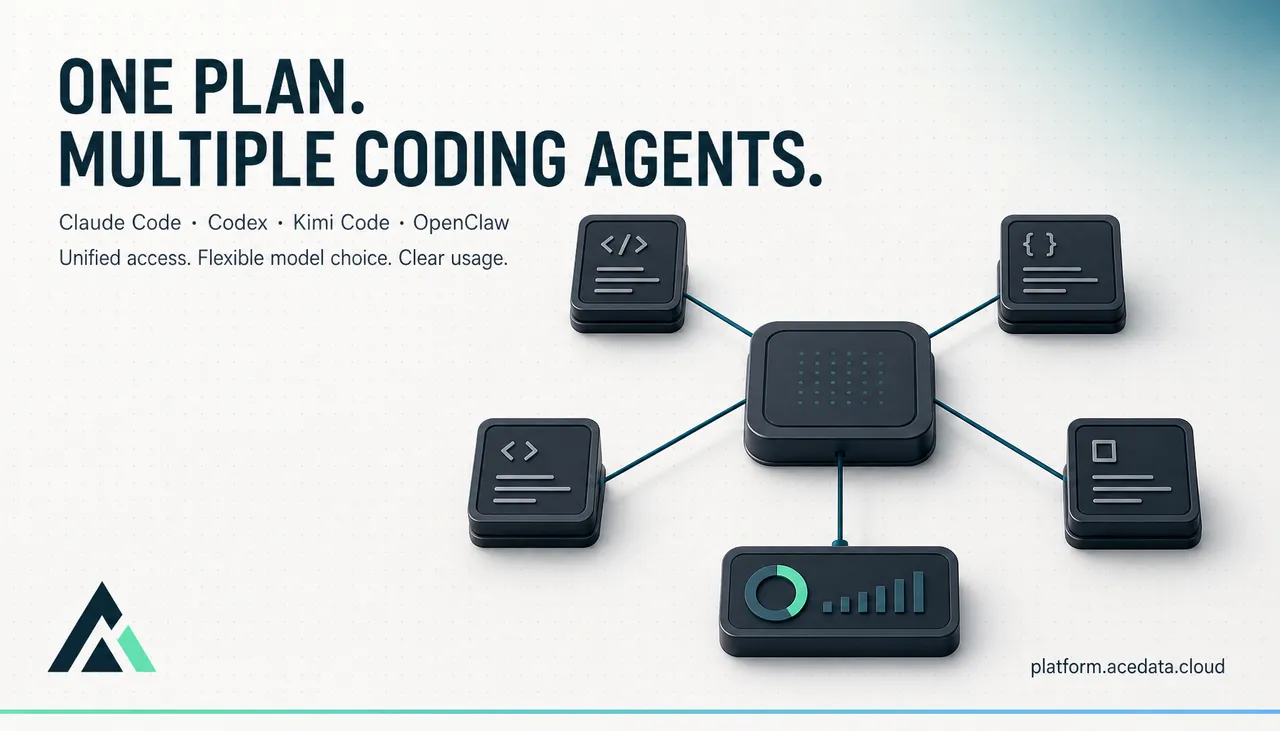
The idea behind Ace Data Cloud Coding Plan is not to create another editor, but to retain the clients developers are familiar with, while consolidating model access, credentials, and usage management into the same Coding application.
Coding Plan currently provides three mainstream interfaces:
- Claude Messages: compatible with clients such as Claude Code that use the Anthropic Messages protocol;
- OpenAI Responses: compatible with Codex Agent workflows;
- OpenAI-compatible Chat Completions: serving Kimi Code, OpenClaw, and various clients that support custom Providers.
The official configuration center already covers tools such as Claude Code, Codex, Kimi Code, OpenClaw, OpenCode, Aider, Cline, Roo Code, Kilo Code, Continue, Qwen Code, and Hermes Agent. You can continue working in the terminal, VS Code, or JetBrains without being locked into a single client.

¶ Which model ecosystems does Coding Plan include?
Coding Plan is not designed for a single model, but covers multiple mainstream coding model ecosystems. The actually available models are subject to the real-time model catalog returned by Coding credentials.
- Claude series: excels at code understanding, complex refactoring, cross-file modifications, and long-task collaboration, and is commonly used in Claude Code workflows.
- GPT / Codex series: emphasizes Agent-style implementation, terminal tool calls, code editing, and validation loops, suitable for Codex CLI and IDE scenarios.
- Gemini series: offers long-context, reasoning, and coding capabilities, suitable for large codebase understanding and multimodal development tasks.
- GLM series: designed for general reasoning and code tasks, providing more choices for Chinese development scenarios.
- Kimi series: emphasizes long-context and Agent user experience, and can be accessed through clients such as Kimi Code.
- DeepSeek series: balances code, reasoning, and cost efficiency, suitable for high-frequency testing, batch tasks, and daily development.
- Grok and other model ecosystems: can be used to supplement reasoning and coding needs in different styles, with specifics subject to the real-time catalog and client compatibility.
This means: architecture analysis can choose stronger reasoning models, daily completion and testing can choose models with a better balance of speed and cost, and models can also be switched when quotas or task characteristics change, without needing to completely replace the workflow.
¶ Starting from ¥99, the four plan tiers have the same model permissions
Coding Plan offers four 30-day plan tiers. All tiers have the same Coding model access range; the main difference lies in the included Credits:
| Plan | Plan quota (Credits) | Price | Applicable scenarios |
|---|---|---|---|
| Coding Plus | 500 | ¥99 | Short projects, test coverage, occasional use |
| Coding Standard | 1,600 | ¥299 | Daily development, multiple repositories, code review |
| Coding Pro | 4,000 | ¥699 | Continuous Agents, complex refactoring, high-frequency use |
| Coding Max | 10,000 | ¥1,399 | Team tasks, multiple Agents, and automation |
The table above is compiled based on publicly available plan information as of October 11, 2026, and records the quotas and prices displayed at the time of verification. Actual purchased quotas, prices, and bonus benefits are subject to the order page and order confirmation. It should be specifically noted: Coding Plan is not “unlimited usage.” Uncached input, model output, cache writes, and cache reads are measured separately, and long contexts, tool calls, and parallel tasks all affect consumption. Plans do not renew automatically, nor do they automatically fall back to using general balance; renewing before expiration allows remaining Credits to roll over and extends the validity by 30 days, while unused Credits will expire after the plan expires.
These boundaries are not drawbacks; instead, they make cost management clearer: you can start with the ¥99 tier to validate your actual workload, then upgrade based on usage, rather than paying for multiple expensive subscriptions from the beginning.
¶ Suitable for Individuals and Teams
¶ For Individual Developers
- No need to maintain multiple overseas subscriptions just to try different models;
- Keep familiar entry points such as Claude Code, Codex, Kimi Code, or OpenClaw;
- Validate actual needs starting from ¥99;
- Choose models by task, rather than being tied to a single plan.
¶ For Technical Teams
- Manage model access through a unified Coding application;
- Centrally view per-request usage to reduce “discovering overspending only at the end of the month”;
- Match different models for refactoring, testing, documentation, and automation;
- Keep clients flexible while establishing clear procurement and usage boundaries.
¶ Start with One Client, Rather Than Migrating All Workflows at Once
It is recommended to first choose one high-frequency scenario for small-scale validation:
- Purchase a suitable Coding Plan;
- Create a Coding Application and obtain a dedicated API Key;
- Open the Coding Plan Configuration Center;
- Select the configuration guide for Claude Code, Codex, Kimi Code, or OpenClaw based on the client;
- Start with code explanation, unit testing, or small-scale refactoring;
- Adjust models and plans based on usage details.
AI programming should not become a subscription management game. A more reasonable approach is to keep the tools you like and regain control over model selection and cost visibility.
View Coding Plan Plans and Pricing, and build your multi-model coding workflow starting from ¥99.