
What is the most frustrating thing about buying an AI coding plan now?
It is not that you cannot find one, but that there are too many choices.
When you see a cheap one, you worry that the models may not be suitable; when you see one with a very large quota, you do not know whether you can use it all. After finally settling on one, you still need to confirm: can it connect to the tools you usually use? If you switch models, do you need to open another account and buy another plan?
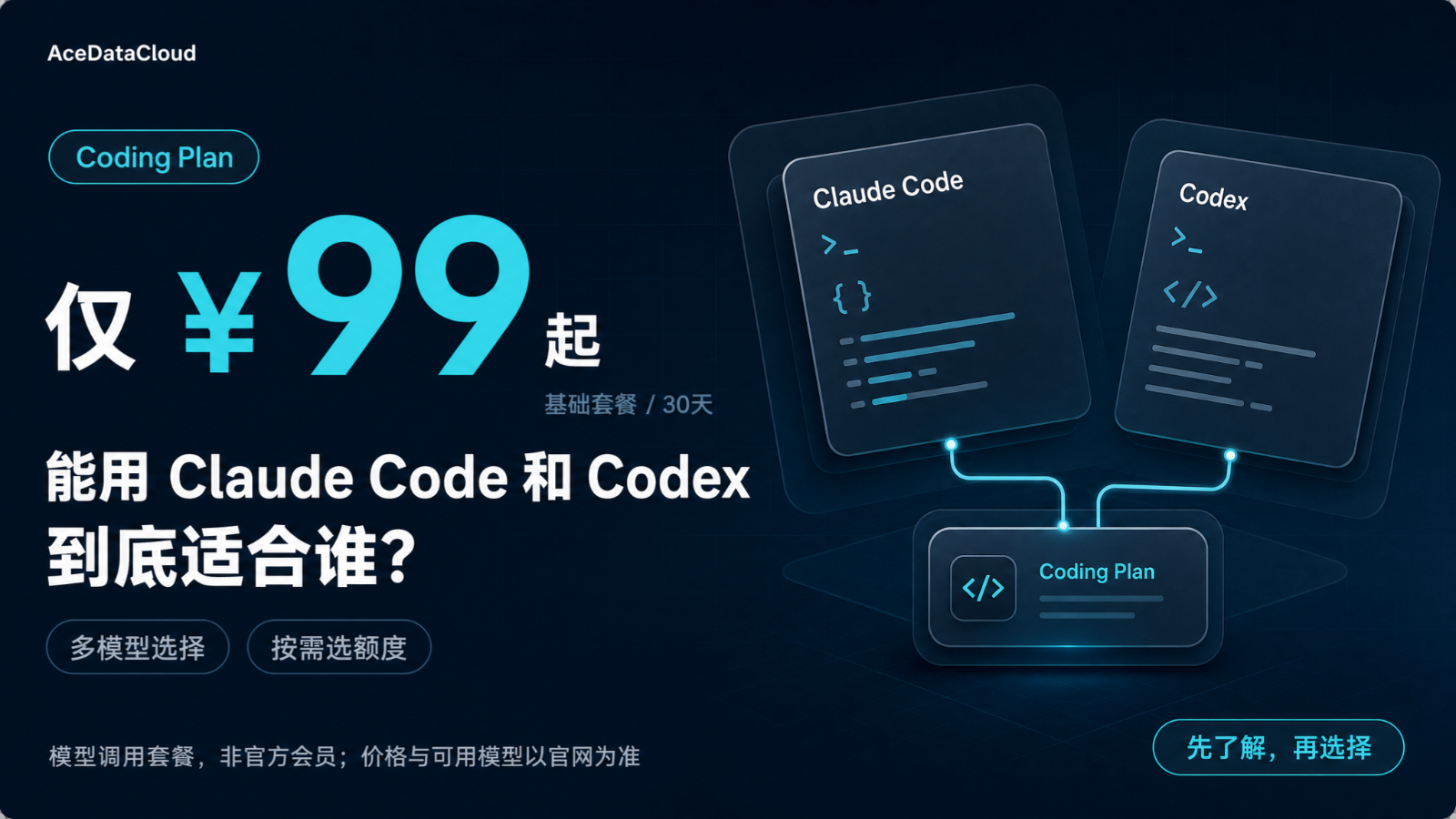
If you are also hesitating back and forth between these questions, you can take a look at AceDataCloud Coding Plan: the page displays plans starting from ¥99, which can connect to coding tools such as Claude Code and Codex, while covering multiple model ecosystems.
However, do not rush to place an order just because of “¥99.”
What exactly does it buy? Is it suitable for you? These questions are more worth discussing than the price itself.
¶ With ¥99, are you buying official memberships for Claude Code and Codex?
No. This distinction must be made clear.
What you are buying here is AceDataCloud's model invocation plan, and then, according to the corresponding guide, connecting it to clients such as Claude Code and Codex. It does not open official subscriptions from both providers for you, nor does it mean you receive all benefits of official memberships.
Does that sound a bit convoluted? In fact, you can break it down into two things:
What tools you are used to using to write code, and what models are invoked behind those tools.
The former is a work habit, and the latter is a model choice.
Some people like using Claude Code in the terminal, while others are more accustomed to Codex. Just because you want to switch models, do you necessarily have to switch development tools as well?
The appeal of plans like Ace lies here: you can start with familiar tools, and then choose available models according to the configuration guide. Its official model coverage description includes ecosystems such as Claude, GPT/Codex, GLM, Kimi, and DeepSeek. Specific versions and combinations are subject to the real-time catalog and the client's compatibility range.
Of course, “multiple models available” does not mean every tool can invoke all models without distinction. Confirming the combination you want to use before purchasing is more comfortable than troubleshooting after buying.
¶ How should you choose the price? I instead do not recommend buying an expensive one at the beginning
First, let us lay out the numbers.
The official page lists the following four plans, with a period of 30 days. Only the base quota is listed here, and limited-time bonuses are not counted as long-term benefits.
| Plan | Displayed price/30 days | Base quota |
|---|---|---|
| Coding Plus | ¥99 | 400 Credits |
| Coding Standard | ¥299 | 1,200 Credits |
| Coding Pro | ¥699 | 3,000 Credits |
| Coding Max | ¥1,399 | 8,000 Credits |
Actual prices and promotional benefits are subject to the checkout page.
“Do you have to buy Pro or Max to use more models?”
This is exactly one point worth noting about it: the model access range is the same across all four plans; the main difference is the quota, not that lower-priced plans open fewer models. The specific models available still depend on the real-time catalog, credential permissions, and client configuration.
So, if you just want to first connect Claude Code or Codex and try it with your own projects, there is no need to buy a higher-tier plan right away.
The significance of ¥99 is that it gives the first attempt a clear budget. It does not mean you can use it unlimitedly, nor does it guarantee the quota can cover an entire month's workload, but you do not need to pay ¥699 upfront for the same model access range.
Before you have figured out your own usage volume, is it necessary to pay for heavy future needs first?
¶ Then how long does ¥99 actually last?
This is a good question, but you cannot casually give an answer like “how many times per day you can ask.”
Even for “help me fix a Bug,” one case may involve changing a dozen lines of code, while another may require reading multiple files, invoking tools, and making repeated modifications. The input context, output length, model selection, and cache status are all different, so the consumption naturally varies as well.
Ace measures uncached input, model output, cache writing, and cache reading separately, so 400 Credits cannot be directly converted into a fixed number of queries.
Rather than listening to someone say, “I cannot even use it all in a month,” it is better to judge based on tasks you would actually do:
- Add tests for a module currently under maintenance;
- Find a cross-file Bug;
- Review a real code change.
First see whether the task can be completed, then see whether the consumption is acceptable. After all, you are buying a plan to get the work done, not to buy a quota number that looks large.
My suggestion is: first purchase the ¥99 basic subscription and try it with your own projects for a period of time. The “trial” here is a paid experience, not a free trial. Focus on whether the integration is smooth, whether model performance meets expectations, and what the actual quota consumption is.
If you find it good after using it, have already started treating it as a daily development tool, and the base quota is not enough, then consider choosing a ¥299 or higher-tier subscription. Is it not safer to first confirm that it works well, and then increase the budget, rather than buying a higher-tier plan at the beginning?
¶ What kind of people is it worth putting it on their shortlist?
I would first think of two kinds of people.
The first kind: people who are already using Claude Code or Codex, but want more model choices.
The tools are already convenient to use, and they do not want to adapt again to a new set of operations. What you need is an additional source of models, rather than collecting another new AI editor.
Ace's configuration center provides integration instructions for Claude Code and Codex respectively, including CLI and VS Code. First check the guide corresponding to your current environment, and you can make a more targeted judgment about whether it is suitable.
The second kind: people who do not want to maintain multiple subscriptions long-term just to occasionally use a certain model.
Perhaps you usually use only one model, and only want to switch to a different approach when facing a difficult problem. Is it worth subscribing for another month for this occasional need?
At this point, a multi-model plan is at least worth comparing. Its value is not in promising that every invocation is the cheapest, but in allowing your choices not to be completely constrained by “who you have already paid for this month.” Conversely, if you only use one model long-term, and your current plan is already sufficient, then there is no need to spend extra money just for “more choices.”
Having more features and being useful to you are two different things.
¶ There are also two rules I recommend understanding before purchasing
One is the balance.
Ace supports carrying over remaining Credits and extending the term by 30 days when renewing before expiration. But if you do not renew when it expires, unused credits will become invalid; purchasing again after expiration will not restore the old balance.
For people whose projects have uneven workloads and who plan to continue using it, this rule has reference value.
But do not, in reverse, buy a new plan that you simply cannot use up just to preserve a small remaining balance. The premise of saving money is always that you actually need it.
The other is the billing boundary.
The Coding Plan does not renew automatically, nor does it automatically use the general balance as a fallback; meanwhile, it still has normal API concurrency and rate limits. So do not understand it as “after purchasing, you can run Agents without limits.”
Making these rules clear is more useful than a simple “use it with confidence.”
¶ So, is it worth buying?
If what you are looking for is the lowest price, unlimited usage, and a plan that works for every scenario, then this article cannot make such a promise to you.
But if your needs are clear:
You want to continue using Claude Code or Codex, retain choices across multiple model ecosystems, and also use ¥99 first to control your trial budget—then the AceDataCloud Coding Plan is worth a look.
There is no need to rush into choosing the most expensive one.
First confirm the combination of models and clients you want to use, then buy a basic subscription tier and try it with your real projects. If it feels smooth, the results are satisfactory, and the quota is not enough, then consider a higher tier.
Whether a plan is suitable ultimately does not depend on how lively its introduction page is, but on whether it can fit into your daily development work at a cost you can accept.
If you are interested, you can start with the official plan page below. First look at the price, then see how your commonly used tools can connect to it. After completing these two steps, it is often more helpful than reading ten recommendation articles.
¶ References and Official Links
- AceDataCloud Coding Plan Details: Source of this article’s prices, base quota, model access scope, billing, and renewal rules; the latest prices and promotional benefits are subject to the checkout page.
- Coding Plan Configuration Center: Provides connection methods, protocol instructions, and configuration guides for clients such as Claude Code and Codex.