

¶ The most exhausting part of creating content is often not writing the article itself.
Every day when you turn on the computer, you first need to check domestic and international news, then go through the trending lists on various platforms. When you come across several pieces of news that look similar, you still have to verify the sources one by one to determine whether it is truly a trending topic or simply being repackaged with a new headline.
After finally choosing a topic, there is still a long list of things waiting to be handled: researching materials, organizing viewpoints, deciding on a title, writing the main text, revising the opening, and then designing prompts for the cover and accompanying images. After the images are generated, you also need to check whether there are any text errors and whether the dimensions are suitable for mobile reading. Finally, save the article and images, upload them to Xiaohongshu, and re-enter the title, main text, and topic tags.
If you only create one piece of content that day, this process is barely acceptable. But once you need to maintain daily updates, or manage multiple platforms at the same time, these repetitive operations will quickly fill up your time.
What truly drains energy is usually not how difficult any individual step is, but the fact that all the steps must be repeated every day.

¶ Rather than repeating operations every day, let the task run by itself
This type of work has one very obvious characteristic: the process is relatively fixed.
It can roughly be organized into the following chain:
Get the latest news → Compare trending topics → Verify sources → Select topics → Write articles → Generate posters → Manual review → Publish content
Since the process is fixed, there is no need to manually start from scratch every day.
Ace Data Cloud's automated task feature can save this process as a scheduled task. Once configured, it will automatically start at the specified time. There is no need to copy prompts every day or keep waiting in front of the computer for results.
You can have the task run every morning. By the time you wake up, the news has already been organized, and candidate topics, article drafts, and matching posters have also been generated. At this point, what you need to do changes from “producing the content all over again” to “checking today's results.”
The actual experience of these two ways of working is very different.
The former requires constantly switching between multiple web pages and tools; the latter only requires focusing on whether the selected topics are appropriate, whether the article viewpoints are accurate, and whether there are any errors in the poster text.
¶ Create a content task that runs automatically every day
After creating an automated task in Ace Data Cloud Studio, you can fill in the task name, execution time, model to use, and specific prompts.
For example, what I created here is a “Xiaohongshu Automated Article and Poster Generation Tool,” scheduled to run at 7:30 every morning.
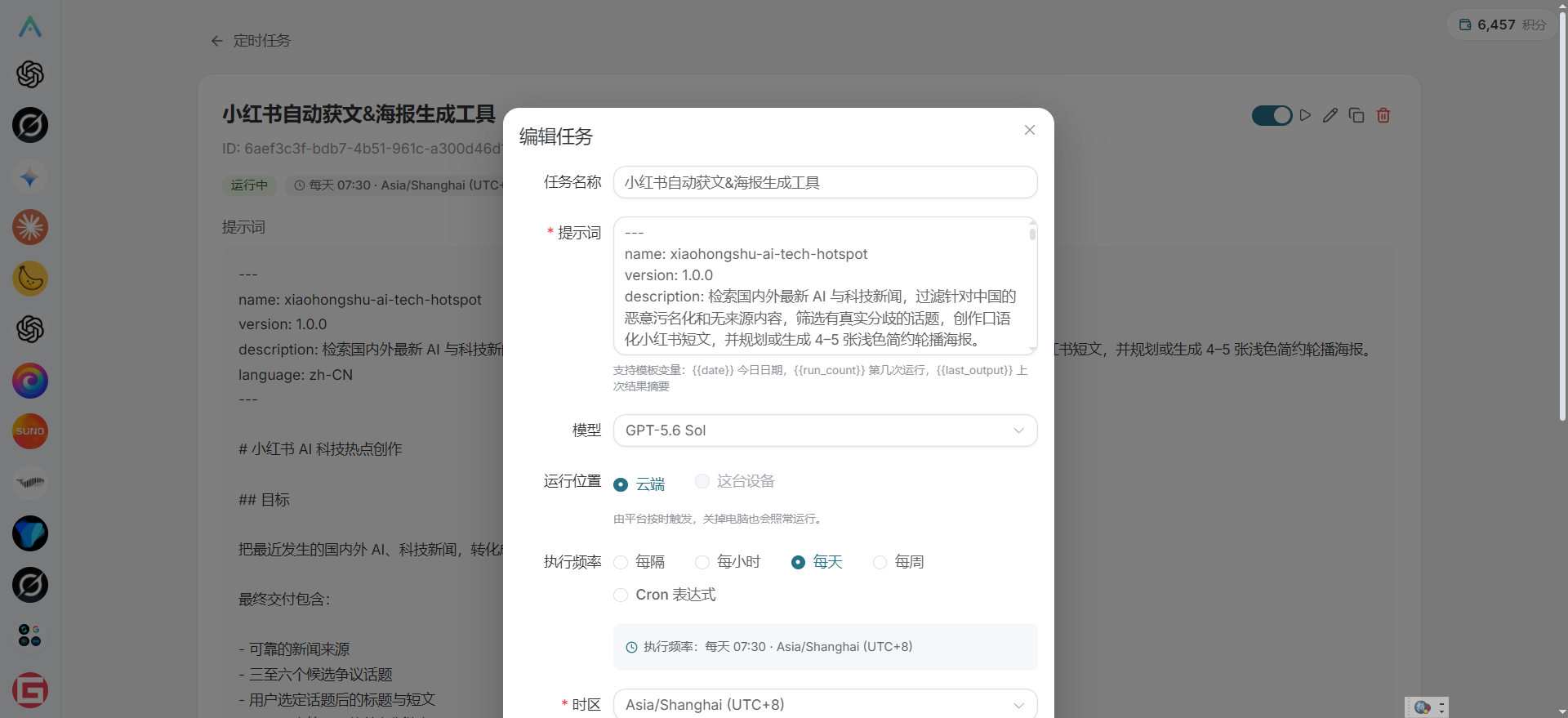
The execution location can be set to the cloud. This way, even if your own computer is not turned on, the task can still run as scheduled.
What truly requires time to adjust is the prompt: in other words, telling the task what it should do every day, how to filter news, and what content it should ultimately deliver.
Compared with temporarily entering something like “help me find a few trending topics,” it is better to write the requirements as a stable set of working standards. For example:
name: xiaohongshu-ai-tech-hotspot
version: 1.0.0
description: >
  Retrieve the latest domestic and international AI and technology news,
  filter out malicious stigmatization and content without sources,
  select topics with genuine disagreements,
  create conversational short articles suitable for publishing on Xiaohongshu,
  and generate 4–5 vertically formatted posters with a consistent style.
language: zh-CN
You can continue adding news sources, topic selection criteria, article tone, poster dimensions, expressions that are prohibited, and whether automatic publishing is needed afterward.
The benefit of doing this is that the standards for the task's daily execution will not easily drift. If it filters according to technology news today, it will not suddenly become entertainment news tomorrow; if source verification is required today, this step will also be retained in subsequent runs.
¶ How my Skill handles trending topics
The main task of this Skill is to obtain new developments in the AI and technology fields every day, and select topics worth discussing further from them.
It does not write an article immediately upon seeing news. Instead, it first organizes the sources, then compares the reporting angles of different media outlets. If a piece of news only has vague screenshots and no reliable source, it will not be prioritized; if multiple media outlets are reporting on it but the content is nearly identical, there is no need to repeatedly generate several similar articles.
The more valuable topics are usually those with genuine room for discussion.
For example, an AI feature may improve work efficiency while also affecting some people's jobs; a company may announce lower product prices, but new usage restrictions may be attached behind the scenes. Such topics are not merely about “what happened,” but can also continue to discuss “what this means for ordinary people.”
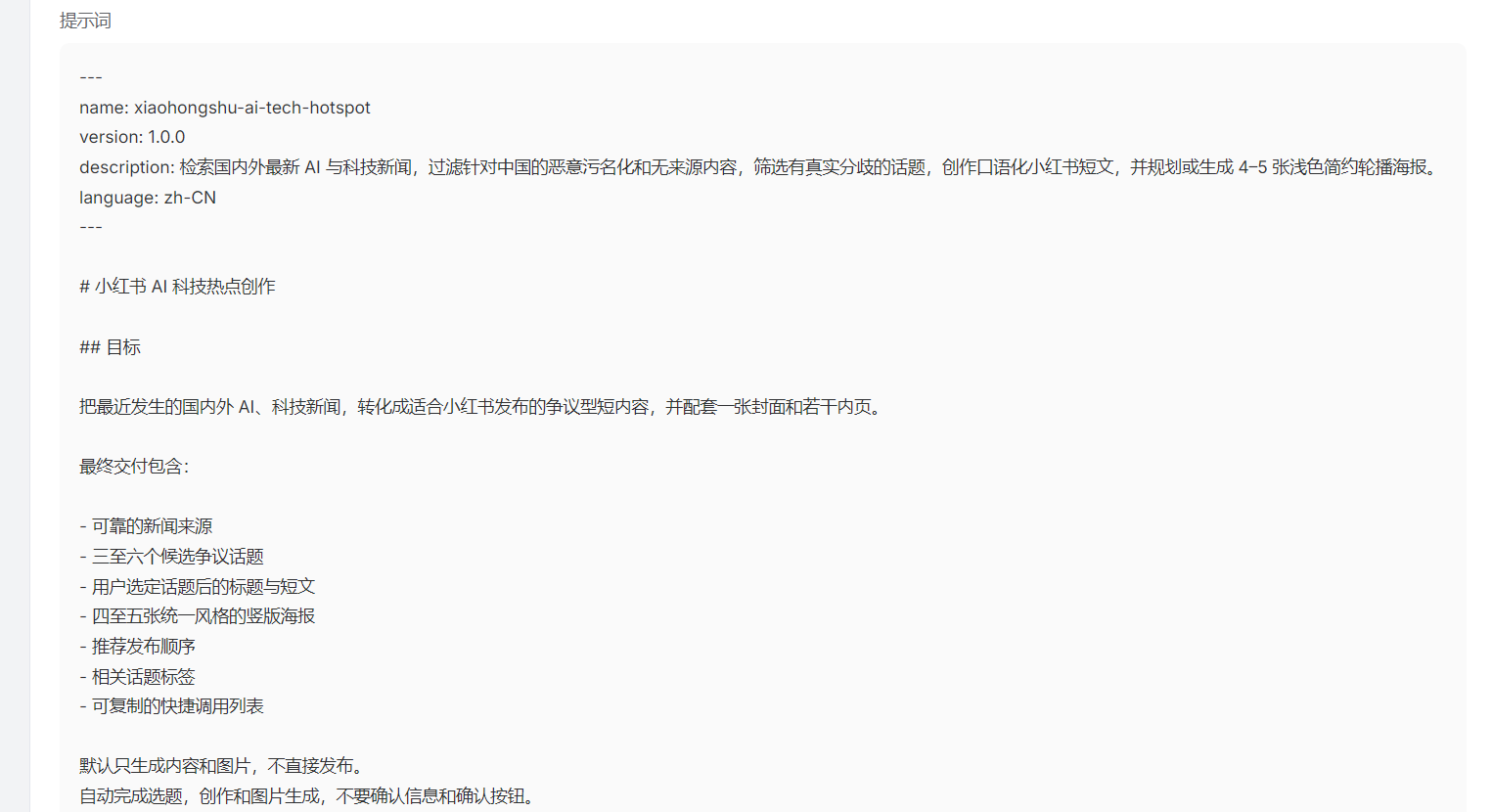
After completing the trending-topic selection, the task will output candidate topics, recommendation reasons, article text, title suggestions, relevant tags, and matching posters.
The articles will try to use short paragraphs suitable for mobile reading, reducing rigid piles of concepts; the posters will maintain consistent colors, fonts, and layouts, avoiding having each image look as though it came from a different template.
¶ What you get after running it once
After the automated task is completed, you can directly view the finished articles and posters on the results page.

At this point, it is not recommended to publish immediately upon seeing the results.
First, quickly read through the article to confirm that the news sources, dates, and key data are correct; then check whether the title is overly exaggerated and whether the main text contains expressions unsuitable for the current platform. Poster text requires particular attention, because typos in images are harder to correct than those in the main text and are more easily noticed by readers.
After confirming that there are no issues, download the posters and publish them together with the article. The work that originally required switching back and forth between multiple tools is now basically centralized on the same results page. The time saved can be used to refine ideas, reply to comments, or continue researching the next topic, rather than being spent on copying, pasting, and repeated uploads.
¶ Xiaohongshu can publish automatically, but I still recommend completing the final step manually
From a functional perspective, the automated workflow can continue through the publishing stage and submit the generated content directly to Xiaohongshu.
However, in actual use, I still recommend keeping the manual publishing step.
Xiaohongshu is relatively sensitive to account login environments, operation frequency, and content behavior. If the account itself is important, there is no need to make the publishing stage take on additional risks just to save the last few minutes.
A more reliable approach is:
Automated tasks are responsible for finding trending topics, verifying materials, writing articles, and generating posters; people are responsible for the final review, downloading images, and completing publication.
This preserves the efficiency brought by automation without handing complete control of the account over to the program.
When publishing manually, you can also temporarily revise the title and cover image based on the situation of the day, add a more natural opening, and choose topic tags that better match the content. These details are often more worthy of attention than “whether to publish completely automatically.”
¶ The same content can also continue to be distributed to other platforms
The value of automated tasks is not limited to generating one Xiaohongshu post every day.
The same verified material can also be reorganized according to the reading habits of different platforms: the Xiaohongshu version can be shorter, retaining more viewpoints and emotions; the blog version can add operational processes, cases, and code; the WeChat Official Account version can supplement background information and make the logic more complete.

Multiple platforms can be connected to automatic publishing, but whether to enable it specifically is best decided according to the platform's circumstances.
For platforms such as Xiaohongshu that are more sensitive to account environments and operational behavior, retaining manual publishing is usually more reliable. Blogs, email newsletters, or other platforms that support interfaces can be connected to the publishing workflow according to actual needs.
WeChat Official Accounts can also be connected directly.
The task first generates articles and accompanying images, saving the content in a pending-review state. After manually checking the title, summary, body format, and cover, publication is then confirmed. This way, there is no need to reformat content every day, nor are necessary content reviews skipped.
The most important thing here is not to pursue “completely unattended operation,” but to hand mechanical work over to automated tasks while keeping decision-making power in human hands.
¶ Automation does not mean ignoring content, but using time in more important places
When configuring a task for the first time, it is still necessary to spend time organizing prompts and determining news sources, filtering rules, writing style, and image requirements. After the task runs several times, it is also necessary to continue making adjustments based on the results.
But these investments are not repetitive daily labor; they are gradually refining a content workflow that can be used over the long term.
Once the workflow becomes stable, what you face every day is no longer a blank document, but a prepared first draft and a set of posters that can be reviewed directly.
Automated tasks will not replace your judgment about what is worth saying, nor will they take responsibility for the content you publish. What they truly save is the highly repetitive work of searching, organizing, transferring, formatting, and generating accompanying images.
If you follow trends, write articles, and create images every day, you might as well first write down your complete work process. Any part that repeats every day with the same steps has the potential to be completed by automated tasks.
Start with a simple workflow:
At a fixed time every day, obtain news, select three topics, generate one draft and a set of posters, and wait for manual review.
After this workflow becomes stable, then consider adding WeChat Official Account drafts, multi-platform rewrites, or automatic publishing. This makes it easier to identify problems and prevents the entire workflow from becoming overly complex from the start.
Finally, if you need more relevant information, you can contact us