
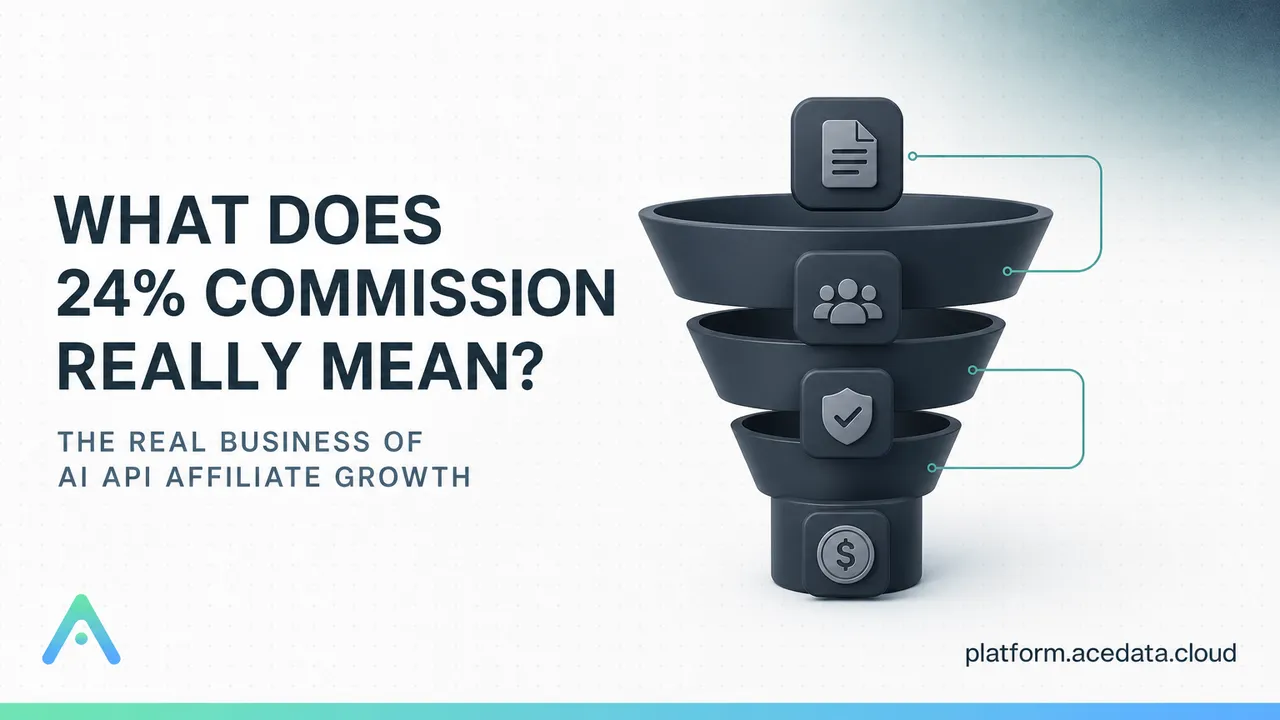
“Up to 24% commission” easily makes people stop and take another look.
But if you simply post this sentence on Moments, together with a registration link, most likely nothing will happen.
Because what users truly care about is not how much you can earn, but: can this platform solve my problem, and is it worth my continued use.
Therefore, if you want to earn revenue through the Ace Data Cloud affiliate program, the key has never been to shout 24% louder, but to find people who truly need AI APIs, image, video, music, or automation capabilities, and use content to help them complete their first successful use.
This article will make this calculation clear.
¶ 24% is not “click the link and get paid”
First, let’s clarify the most easily misunderstood point.
Earnings from the Ace Data Cloud affiliate program are based on real customers and completed orders that comply with the rules. After customers register through your exclusive link and establish a valid referral relationship, and complete eligible top-up or purchase orders, the system calculates earnings based on the valid commissionable amount, affiliate level, and applicable revenue-sharing rules.
Clicks, registrations, and individual API calls themselves do not directly generate promotional commissions.
The current public levels start at 10% and increase progressively as cumulative thresholds rise, reaching up to 24%. Specific levels, thresholds, attribution scope, and settlement results are subject to the real-time rules on the official page.
Therefore, the following three things are not equivalent:
- Someone read your article;
- Someone clicked your link;
- Someone registered through a valid referral relationship and completed an eligible top-up or purchase order.
Only the third situation may generate a commission, subject to attribution, order status, and settlement rules.
This is also why 100 casually registered users may not be more valuable than 10 developers who genuinely need to build projects.

¶ First, do the simplest calculation
Assume that for a completed order from an attributed customer, the valid commissionable amount is USD 100, the following rates are the rates actually applicable to you, and there are no other adjustment items:
| Example applicable commission rate | Example commission |
|---|---|
| 10% | USD 10 |
| 15% | USD 15 |
| 20% | USD 20 |
| 24% | USD 24 |
This table only illustrates the calculation method of “valid commissionable amount × actually applicable rate” and does not represent an earnings promise. The valid commissionable amount must be verified according to the order and rules; upstream and downstream revenue sharing, refunds, risk control, and other adjustments may all affect the final result. Credits consumed by APIs cannot be directly entered into this table.
From the perspective of long-term promotional results, three factors also need attention:
The right customers, real usage, and continued retention.
They affect whether customers are willing to purchase and repurchase; each commission is still settled based on eligible valid orders.

The illustration shows growth factors and is not a commission settlement formula.
Focusing only on the rate means overlooking the most important part of this business.
¶ The first variable: who exactly are you bringing in?
If the article title is “Register to get benefits,” it may bring in many people who only want to claim a one-time trial.
If your article solves “How to batch-generate product images with Python,” the people who find it are more likely to be building e-commerce tools, automation scripts, or client projects.
Both types of traffic may look like a single visit, but their value is completely different.
High-quality customers usually have several obvious characteristics:
- They are working on a specific project;
- They already know what type of AI capability they need;
- They care about APIs, stability, pricing, and documentation;
- After their first successful test, they may continue using it;
- They will need more models or services later.
Therefore, the first principle of affiliate promotion is not “get more people to click,” but let the right people see the right solution.
¶ The second variable: can the content help users cross the first hurdle?
Registering for AI products is not difficult; the difficult part is succeeding the first time you use them.
Users often get stuck in these areas:
- They do not know which model to choose;
- They do not know how to configure an API Key;
- They cannot understand the request parameters;
- They do not know how to check asynchronous tasks;
- They do not know where the problem is after an error occurs;
- They worry about costs getting out of control and do not dare to continue testing.
What a good article should do is remove these obstacles one by one.
For example, if you write about an AI video API, do not only show the finished result. Clearly explain the request examples, parameter descriptions, task queries, failure handling, and cost entry points. When readers successfully generate their first video by following the article, registration is no longer an empty number, but a real product experience.
¶ The third variable: why would customers continue using it?
A single tutorial solves “can it be used,” while follow-up content solves “how can it be used better.”
Users’ continued usage usually comes from three types of needs:
- Advanced needs: moving from single generation to batch calls;
- Combined needs: expanding from text to images, videos, music, or search;
- Business needs: moving from personal testing into products, teams, or client projects.
This is exactly where a unified AI platform has an advantage. Users do not need to search for a new platform or manage new accounts and interfaces every time they switch capabilities. Promoters can also continue writing about different scenarios for the same group of users, instead of finding an audience from scratch every time.
¶ Truly effective promotional content usually looks like this
¶ Type One: Problem-based tutorials
The title directly answers a specific question:
- How do you switch compatible interfaces with the OpenAI SDK?
- How do you call an image generation API with Python?
- Why does an image-to-video task keep failing?
This type of content has clear search intent and can easily bring in high-quality users.
¶ Type Two: Cost and selection
When users are preparing to enter real projects, they will care about:
- Which model is more suitable;
- How to choose between pay-as-you-go usage and fixed subscriptions;
- How to divide work between fast models and high-quality models;
- How to control batch calling costs. These types of articles are closer to actual purchasing decisions, but real-time prices must be used to avoid exaggeration.
¶ Category Three: Complete Cases
Rather than saying “the platform supports AI video,” it is better to show:
How to generate a short video from product images and connect it to an automated workflow.
Cases allow users to directly see the results and make it easier for them to imagine how they would use it themselves.
¶ Why Is Simply Posting Promotional Links Usually Useless?
Links have no context.
Users do not know why they should click, what to do after entering, or how the product relates to their own problems. Even if they register, they may leave soon afterward.
Content provides context:
- This is my problem;
- This is the solution process;
- This is the actual result;
- This is the entry point for the next step.
When a link appears here, it is not an advertisement, but the final step of the solution.
¶ A More Reliable Set of Promotional Actions
If you are preparing to do this seriously, you can start in the following order:
- Choose a user group you are familiar with; do not try to do everything at the beginning;
- Identify the 5 questions this group asks most often;
- Use Ace Data Cloud to actually work through one of them;
- Write a complete tutorial rather than a feature introduction;
- Include your exclusive link and a clear next step at the end;
- Continue writing advanced content based on reader feedback;
- Regularly check which content has generated real usage, rather than only looking at page views.
The most important part is all the steps before step five.
Without the value provided earlier, that final link will not generate revenue on its own.
¶ So, What Does 24% Actually Mean?
It means that when you consistently bring high-quality customers and reach the corresponding affiliate tier, completed orders that meet the rules may be counted toward promotional earnings at a higher applicable rate.
But it does not mean guaranteed income, nor does it mean you can skip product value and customer service.
The underlying logic of this business is very simple:
You help users solve problems faster, help the platform find real customers, and the system then records this contribution according to the rules.
If you have a technical blog, an AI community, developer readers, or enterprise clients, this model is worth taking seriously; if you only have one link and do not yet have any content or scenarios, then do not rush to talk about 24%.
First write an article that truly helps people successfully use the product.
- View Ace Data Cloud promotion methods and commission rules
- Enter the promotion center to obtain your exclusive link
- Browse platform services and development documentation
Note: The calculations in this article are only used to explain the rates and do not constitute income forecasts or commitments. Actual earnings depend on the valid commissionable amount of orders that meet the rules, the actual applicable rate, attribution, and settlement rules. Please refer to the real-time information on the official pages.